r .column-left-inner, column-left-outer { background: $(sidebar.bgl.color); } .column-right-inner, column-right-outer { background: $(sidebar.bgr.color); } .sidebar-right, .column-right-outer, #sidebar-right-1, .sidebar { background-color: #F5F7FA !important; padding: 15px; }

Translate / Traducir

Showing posts with label observing. Show all posts

Lindsay-Shapley Ring


A Peculiar Galaxy, an interesting Target for Big Telescopes, Resides in the Far Southern Skies


As a visual observer, galaxy morphology has always been a very exciting topic for me. To observe different kinds of galaxies, from the classic elliptical and spiral ones to those in groups and clusters showing peculiar shapes is something very interesting, especially if you have a chance to use a big telescope that allows you to detect the fainter and finer details of them. Among the peculiar members in the world of the galaxy morphology, we have the so-called annular galaxies or ring galaxies. As James L. Higdon et al. state in their paper "Why Are Ring Galaxies Interesting?" (2010), these objects are formed by the near central passage of a companion through a spiral along the rotation axis. The brief additional gravitational force induces epicyclic motions throughout the disk, which act to form radially propagating orbit-crowded rings of gas and stars. On other of their papers, James L. Higdon et al. argue that ring galaxies are striking examples of the ability of collisions to transform both the morphology and star-forming activity of a spiral galaxy. Numerical studies since the mid-1970s argue persuasively that the optically prominent rings are in fact outwardly propagating zones of strong orbit crowding within the disk of a spiral induced by the near central passage of a companion galaxy ("Wheels of Fire. IV. Star Formation and the Neutral Interestellar Medium in the Ring Galaxy AM1 0644-741" 2011).

The 24-inch telescope at the "Altos Limpios" Nature Reserve. 
Photo by the author.
If you are observing in the Southern Hemisphere during the summer season take a look, for a moment, to the Large Magellanic Cloud. It is a must-to-see object because of its size, brightness, and remarkable structure. Well, now aim your eyes about 8 degrees southeast of that galaxy. In that region of the sky, more specifically in constellation Volans, an interesting annular galaxy resides, 300 million light-years away. I´m talking about PGC 19481, also known as Graham A, the Southern Ellipse, AM 0644-7411 (Arp & Madore 1987), or Lindsay-Shapley Ring.

A way to find this peculiar galaxy is to look for the 5.1 magnitude star alpha Mensae, one of the stars that are part of the inconspicuous constellation Mensa. The galaxy lies about 2.1 degrees east-northeast of it. The J2000 coordinates of the nucleus of this galaxy are R.A. 06h43m06.s18   Dec. −74◦14 10".7.

The Lindsay-Shapley ring galaxy (AM 0644-741) appears in Category 6 of the Arp Madore catalog of Southern Peculiar Galaxies and Associations, a category that includes any galaxy with an apparent luminous ring around it, and attempts to exclude objects which appear to be spiral galaxies which have had their arms tightly wound into nearly circular appearance.

Below, there is a short video by Chandra Observatory about this enigmatic object in the Southern Sky,


Figure 1. Field of view of the Lindsay-Shapley Ring galaxy. 
"In AM 0644 741, we see a strong ring of bright blue stars in the Cerro Tololo Inter-American Observatory (CTIO) and Hubble Space Telescope (HST ) images, with associated HII regions. Unlike the Cartwheel, which shows spokes and is presumed to be a second ring-formation event (Struck-Marcell & Higdon 1993), AM 0644-741 is likely to be the first ring formed" (see the paper "Dynamical Parameters for AM 0644 741" Alex Antunes and John Wallin (2007).

As can be read on the paper "Morphology and enhanced star formation in a Cartwheel-like ring galaxy", F. Renaud et al. 2017), the Lindsay-Shapley Ring galaxy also displays an enhanced star formation activity in the furthest quadrant of its ring to the nuclei (Higdon et al. 2011).

The picture at the top of this article shows the 24-inch (0.61 meters) used to observe this galaxy. It was set up in a good field in the ranger station at the nature reserve named "Altos Limpios". You need to drive for almost 2 hours northeast from Mendoza City, in Argentina, to reach it. It is important to say that I saw this galaxy when it was about 32 degrees high in the sky (it reaches 48 degrees at its highest) and seeing was not the best that night, so maybe better results regarding the structures seen in this galaxy can be achieved with better-seeing conditions and with the galaxy at higher altitude.

The galaxy was searched, at the beginning of the observation, using 98x. After several minutes scanning the area the target was found, appearing, at this magnification, as a subtle nebulosity close to a quasi-stellar hazy spot when observing with averted vision, which is, actually, the core of the galaxy. The ring diameter, in arcsec, is 85 x 49. An asterism formed by 4 stars of magnitudes between 12 and 12.9 for those labeled in Figure 1, and magnitude 14.5 for the fourth one in the asterism labeled with a blue circle, was useful to confirm that the area was the correct (see Figure 1). A star indicated with a black arrow in Figure 1, is visible close to the galaxy´s nucleus.

Figure 2. DSS image of the Lindsay-Shapley Ring galaxy and its 
companions.
The Lindsay-Shapley Ring galaxy seems to be a member, according to the SIMBAD Database, of a small group of galaxies. The two nearest galaxies (at least in projection on the sky) were also detected through the 24-inch telescope. I´m talking about the galaxies LEDA2 19455, situated about 1.2 arcmin southeast of the target galaxy, and LEDA 19454, 1.05 arcmin to the north- northeast (see Figure 2). The first one, a distorted elliptical, was visible using averted vision as a small hazy patch. Both Graham (1974) and Few, Madore, and Arp noted an extended and low surface brightness light distribution between the ring galaxy and LEDA 19455. Partly on the basis of this emission, these researchers concluded that LEDA 19455 was the intruder galaxy. The other companion, fainter, was hardly visible using also averted vision.

Applying a little higher magnification (i.e. 122x), the view was similar to that one at lower magnification. However, the nucleus of the galaxy seems to be a little easier to see, like a faint defocused star. The outer part of the galaxy, including of course the ring structure, shows up when averted vision is applied, appearing as a slightly elongated nebulosity. It is not easy to see, and the beautiful structure seen in those detailed and colorful pictures provided by ground-based telescopes and the Hubble Space Telescope is not detected. The view is rather blurry and faint. The nearby galaxies are again visible, looking faint. LEDA 19455 appears similar to the nucleus of Lindsay-Shapley Ring galaxy, both in size and brightness.

203x is a good magnification to observe the group of galaxies. LEDA 19455 looks now brighter and its presence there is undoubtful, showing a round shape. The LEDA 19454 galaxy is fainter, as said before, but it can be detected. The central part of Lindsay-Shapley Ring galaxy looks bigger and its brightness seems to be smooth. When the galaxy is observed with averted vision, an arc-shaped structure of very faint nebulosity is visible just south of the nucleus

Figure 3. Picture credit of James L. Higdon and John F. 
Wallin, appearing as Fig 2 in their paper "Wheels of 
Fire. III. Massive Star Formation in the "Double-Ringed"
ring galaxy AM 0644-741".  
The view of the galaxy is interesting at 244x. The nucleus is easily visible through this instrument. The whole galaxy looks like a rather elongated nebulosity, a ghostly nebulosity among the surrounding stars in the field of view of the telescope. At this power and observing more carefully, some of the structure, very faint, and indicated with an arrow in Figure 2, seems to be detected for moments. AM 0644-741 possesses twin interlocked rings, each with slightly different centers, position angles, and ellipticity. The double-ring structure makes AM 0644-741 unique among ring galaxies, much like the Cartwheel and its network of spokes. A total of 54 H II complexes were identified in the rings using Figure 2a of the paper "Wheels of Fire. III. Massive Star Formation in the "Double-Ringed" Ring Galaxy AM 0644-741" by James L. Higdon & John F. Wallin (1997). I think the slightly brighter portion visible there, barely visible even with averted vision, are some of the HII regions present in the galaxy. The authors of the mentioned paper state that the most luminous H II complexes tend to be found near the intersection of the A-ring and B-ring (see Figure 3 here) which occurs in an area of the galaxy coincident with the one I observed, indicated with the arrow in Figure 2.
In the SIMBAD Database web page, two x-ray sources are indicated as present in that area also (i.e. [WFM2018] AM0644x1, and [WFM2018] AM0644x2.).
A long time ago, something amazing happened in this distant galaxy, and you can be a witness of that when observing it from a dark sky site.


1 _ Catalogue of Southern Peculiar Galaxies and Associations (Arp, Madore): 6,445 peculiar and interacting galaxies found on IIIa-J southern sky survey plates, types, positions, and characteristic sizes, cross-identifications and selected photographs. 

2 _ (Lyon-Meudon Extragalactic Database). Extension of PGC catalog in the Lyon-Meudon Extragalactic Database 1989: Catalogue of principal galaxies, 1ST edition: N=73197.
The first designation was PGC, but PGC and LEDA are now equivalent.


The Coddington`s Nebula


This Member of the Nearby M81 Group Shows an Intriguing Structure 
that Amateur Astronomers can Observe Through their Telescopes


Figure 1. IC 2574, in constellation Ursa Major. Photo by the author.
A summer night in the Northern Hemisphere, the sky looks good for observing deep-sky objects. However, it is important to say that the conditions were not the best at all. I consider important to mention this in case you want to compare your own observation of this faint galaxy with the report posted here. 

This article is devoted to IC 2574 (also  UGC 5666, DDO 81, and VII Zw 330), an interesting dwarf galaxy discovered by the american astronomer Edwin Foster Coddington on a photographic plate using the Crocker Photographic Telescope at Lick Observatory (University of California, USA), in 1898. This object is part of the M81 group which contains 30 members, being Messier 81, NGC 2403, and NGC 4236 the brightest ones (book "The Cambridge Photographic Atlas of Galaxies" by Michael Kônig Stephan Winnewies). M81 group is one of the nearest prominent groups in the vicinity of the Local Group. 

The IC 2574 galaxy is located at a distance D = 4.02 Mpc (1 arcsec = 19.5 pc) according to Karachentsev, Makarov & Kaisina (2013), paper "The Supergiant Shell with Triggered Star Formation in the Dwarf Irregular Galaxy IC 2574: Neutral and Ionized Gas Kinematics" O. V. Egorov,1‹ T. A. Lozinskaya,1 A. V. Moiseev1,2 and G. V. Smirnov-Pinchukov1 (2014).


Figure 2. IC 2574 and its surrounding field.
When you are ready to observe, in a site as dark as possible because we are talking about a faint object, aim your telescope to the region indicated on Figure 1, just north of the Big Dipper. This galaxy lies about 22 degrees from the well known star Polaris.

IC 2574 hosts many HI holes and also an interesting structure to be observed through big telescopes, a Supergiant Shell1 (SGS) of ∼1000 × 500 pc in deprojected size (Walter et al. 1998; Walter & Brinks 1999; Cannon et al. 2005). The SGS, as well as many holes found in IC 2574, is surrounded with HII regions likely triggered by the stellar feedback related to the star-forming event that occurred in the hole center ∼25 Myr ago (Walter & Brinks 1999; Weisz et al. 2009). The SGS is located in the northwest region of IC 2574 and created by a significant burst of star formation in its center. It is likely responsible for triggering a ring of star formation around it (Walter et al. 1998; Walter & Brinks 1999; Pasquali et al. 2008) See paper "Hunting for Young Dispersing Star Clusters in IC 2574 ", Anne Pellerin, Martin M. Meyer, Daniella Calzetti, and Jason Harris (2012).

A few questions arise now, how much details can we see in this galaxy through an amateur telescope? Are the components of the supergiant shell visible?

This article was written based on observations I made using an 18" (45cm) f3.5 telescope. I first found this galaxy using low power (45x). The group of stars labeled with a circle on Figure 2 was useful to identify the surrounding field and to find the galaxy which was visible at this low power. With a visual magnitude of 8.2 HD 90820 is the brightest star in the 1 degree field of view. 

At 45x, IC 2574 looks like a "rather smooth nebulosity" elongated northeast-southwest with a small area appearing slightly brighter, even though is faint and round. This area is indicated with an arrow in Figure 2 and is the aforementioned supergiant shell. We are talking of a rather faint object even for an 18-inch telescope, at least under the sky conditions in central Oregon in 2018 summer, when this observation was made. It is important to say that the sky conditions were good enough for carrying out this observation but it was not an excellent sky, so maybe observers with the same kind of telescope under a darker and more clear sky might be abble to see this galaxy and its features a little better or easier.

Figure 3. Working with a DSS image I tried here to reproduce 
how the galaxy looked through the 18-inch telescope. Faint target, 
with the two "brighter" areas indicated with squares on the picture.
North is down. South is up.
At 61x the galaxy looks again smooth and clearly elongated, faint in brightness. Using averted vision two areas are slightly brighter than the rest (see Figure 3). However, the whole object is hard to see.

While the structure to the south end looks smooth in brightness and bigger than the other one, the north patch appears round and smaller. Observing carefully, some star-like structures seems to be visible in this region. Figure 4 to the left is a picture taken from the paper  "The supergiant shell with triggered star formation in Irr galaxy IC 2574: neutral and ionized gas kinematics". O.V. Egorov , T.A. Lozinskaya , A.V. Moiseev , and G.V. Smirnov-Pinchukov. This picture shows the giant HII regions on the HST/ACS F658N image of the SGS area according to the list of Stewart & Walter (2000). Bottom panel on Figure 4: location of the star clusters on the same image. The clusters identified by Pellerin et al. (2012) are shown by blue. The red circles denote the clusters from Cook et al. (2012). The four largest green circles show the star clusters identified by Yukita & Swartz (2012).

121x. This is an intersting magnification to see IC 2574. It is a faint object so averted vision is always necessary to glimpse and identify its structures. A very challenging glimpse of a small nebulosity is possible for moments when observing carefully, I´m talking about [MH94a]3 IC 2574 203 and [MH94a] IC 2574 218, a small object composed of two HII regions. The bigger structure, to the south, looks again smooth (featureless). Although faint, the smaller northern feature is a little easier to detect, appearing slightly more detached against the surrounding stars. Some of the components on that zone (appearing star-like in shape) are barely visible. Using averted vision, PMC20122 13z, the brightest component according with what can see on a DSS image, seems to be the "easiest" part to pick up visually. PMC2012 13z is a star-forming complex – an extended (∼ 450 × 320 pc) fine-filamentary HII region, located in the northern wall of the SGS. Yukita & Swartz (2012) identified the young star cluster C1 inside Region.

162x. At this power the small object composed of two HII regions
Figure 4. Credit O.V. Egorov et al. 
 is visible with averted vision (see Figure 5). It is a faint feature of the galaxy however. At this magnification the aforementioned areas of the galaxy seems to be connected by faint nebulosity, without a doubt part of the galaxy, appearing clearly elongated. Observing carefully, some components of the supergiant shell seem to jump to the view but it is not possible to see them clearly and discern and identify each one. The component of the supergiant shell, PMC2012 13z,
 an association4 of stars according to SIMBAD Database and the STScI Digitized Sky Survey web page is certainly visible appearing cuasi-stellar in size and with a hazy nature. The UHC filter slightly improves the view of the smaller patch of the galaxy. Even PMC2012 13z appears more nebulous.

Both the STScI Digitized Sky Survey web page and SIMBAD Database agree that CVL20095 UGC 5666-3, the brightest nebula in the SGS, is an HII region that looks rather non-uniform and consists of a central nebula ≃ 120 pc wide, several more compact (≃ 10 − 20 pc) clumps that surround it, and two faint external shells southeast and northwest of the region with the sizes of ≃ 20 pc and 35 pc.

Figure 5. The supergiant shell and its main components.
Another association of stars, PMC2012 21z, is a region that has the form of a bright ‘halfshell’ whose eastern part adjoins the dense wall of the SGS, with a fainter filamentary inner part. The full size of the region is about 250 × 150 pc.

While some star-like structures seem to be visible briefly and with difficulty in this galaxy, as was mentioned above, the view is difficult and unclear, so I can not claim to have identified these last two features of the SGS visually. The only patch visible there seems to be the brightest one on Figure 5, PMC2012 13z. 

IC 2574, one of the many outstanding and enigmatic galaxies that we can find in a dark sky, is a good target to put your eyes and telescope under proof and see how much you can detect under ideal observing conditions.


____________________________________________________________________________________________________________________________________

1_ SGS Irregular galaxies reveal giant HI supershells and holes with sizes as large as 1 – 2 kpc and lifetimes up to several hundreds Myr. Giant supershells and holes in some galaxies represent the dominant feature of the ISM. Such large structures are usually called supergiant shells (SGS), or giant supershells. Formation mechanisms of supergiant shells have been discussed extensively in recent decades

2_ [PMC2012] - (Pellerin+Meyer+Calzetti+, 2012)

3_ [MH94a] (Miller+Hodge, 1994)= (MH)as appears in SIMBAD Database

4_ The concept of a stellar association was originally introduced in 1949 by V. A. Ambartsumian, who later separated them into OB and T associations (Ambartsumian 1968). Morgan, Sharpless, & Osterbrock (1952) considered as a stellar association any loose group of stars within an area where bright OB stars exist and with evidence of a common origin.

A recent definition of a stellar association (Kontizas et. al. 1999) refers to it as a single, unbound concentration of early-type luminous stars, embedded in a very young star forming region.

5_ [CVL2009] - (Croxall+van Zee+Lee+, 2009)as appears in SIMBAD Database


The Aggregate Shapley I in LMC


Nebulae and stellar associations reside in this complex in the central region of the Large Magellanic Cloud. How much can we see through an amateur telescope?


It is Spring in the Southern Hemisphere, so it is time to aim a telescope to one of our satellite galaxies, the Large Magellanic Cloud (hereafter LMC), and find another interesting structure there. The Magellanic Clouds show a large variety of bubbles, superbubbles and supergiant shells among its objects, many of them being visible for the amateur observers with common telescopes.

"McKibben and Shapley (1953) were the first to distinguish the giant stellar and gaseous groupings of the LMC, the well known Shapley constellations I - V. Later, van den Bergh named (in 1981) the constellations VI - IX. These seem to be the most active star forming areas of the LMC" (paper "Morphology and Stellar Content of Complexes in the Large Magellanic Cloud" M. Kontizas et al. 1995).


This video by ESO`s VLT is a zoom-in view of the interesting group of nebulae and OB stars  named LHa1201 N44, one of the targets you can observe with an 8-inch telescope.

This article deals with this complex which is also known as "Shapley Constellation I"  according to the LMC extended catalogue (Bica+ 1999) published in VizieR web page. N44, cataloged by Henize (1956) and named DEM2 150, 151 and 152 by Davies et al. (1976) is a luminous HII complex in LMC. It contains an assortment of compact HII regions, filaments, and shells of all sizes, as well as three OB associations3, LH447, 48, and 49 (Lucke & Hodge 1970). N44 is dominated by a prominent shell around LH47 in the central region (Chu & Mac Low 1990), paper "The Multi-Phase Medium in the Interstellar Complex N44" by Sungeun Kim et. al. 1998. Situated at RA 05 22 06.9 Dec -67 56 46, N44 lies (see Figure 1) about 43 arc minutes southwest of a curious structure named "Sextant" (see the article "An enigmatic Structure in the Local Universe - part 2" in this blog). 

The observation was made from Uspallata valley, in Los Andes mountains, where the dark skies make possible to carry out this kind of projects. 

Figure 1. Position of the complex N44 in LMC. North is up.
Two main hazy regions are visible in the field of view at a first observation at 48x. I call them "northern region" and "southern region" (see Figure 4). The northern region is bigger than the other one but both look pretty similar in the sense that they show several faint stars embedded in nebulae structures. I identified this complex after recognize the T-shaped asterism formed by the stars HD 35862, GSC-9162-0453, HD 35978, and GSC-9162-0321 (visual magnitudes 9.3, 11.4, 9.7, and 11.4 respectively). The brightest star in the field of view is the 8.5 magnitude HD 35665. According with data given by the aforementioned catalogue (Bica 1999) the center of Shapley Constellation I lies at the center of the bigger region (indicated with the blue arrow in Figure 4). This aggregate has an overall dimension of 23 x 16 arc min and an angular position of 150° according with the same source (See Figure 2).

Matching with what can see on the DSS image (Figure 4), the area labelled with an ellipse is where nebulosity and stars are visible at this power. That is the area of the association LH49 and the HII region IC 2128 (also N44D). I found discrepances about the nature of IC 2128. Some sources (e.g. SIMBAD Database) state that is an HII region while others (like the revised NGC/IC catalogue and STScI DSS) say it is a stellar association. Beyond that differences, it is not a conspicuous object at all. The section easier to detect (a little better using of course averted vision) is the more contrasted patch on DSS image in Figure 4 immediately southwest of the 9.7 magnitude star HD 35978, appearing as a faint and defocused star engulfed, in turn, by very subtle nebulosity. Averted vision is necessary to get this view through an 8-inch telescope at low magnification. 

Figure 2. According with the LMC extended catalogue (Bica 1999)
Shapley constellation I is a 23x16 arc minutes wide structure with
an angular position of 150 degrees. North is up. East to the left.
Moving to the northern section of the complex, N44C (also NGC 1936, IC 2127) seems to be the most prominent nebula there, looking round and small.

A little higher magnification (63x) shows very subtle nebulosity encompassing the northern half of the "T" asterism. To the northeast, very faint and challenging is the view of the small component N44E (see Figure 4). With averted vision a ghostly nebulosity is visible. For moments, 2 or 3 stars can be discerned there. We will analize that region again using higher power.

At 63x, N44C is the most contrasted nebulosity visible in the whole complex. Stasinska et al. (1986) favour radiative radiation of N44C by a central star whereas Pakull & Motch (1989) suggest that it could be a fossil, X-ray photo ionized nebula formed by a now
Figure 3. LH49 & N44D
quiescent X-ray binary system. "The bright main body of N44C has the appearance of a normal H II region, apart from its high excitation and He II emission. The east, northeast, and northwest boundaries of N44C are relatively sharp and have low [O III]/Ha, indicating the presence of an ionization front" (paper "The He II Emitting Nebula N44C in The Large Magellanic Cloud: Optical/Ultraviolet Spectroscopy of the Nebula and its Ionizing Star" Donald R. Garnett et al. 2000). The area southwest of N44C is visible with averted vision as a rather smooth hazy spot. N44B is round in shape but slightly fainter and smaller than N44C. Even fainter is another round nebulosity, DEM L 140, to the northwest of N44B. It is smaller than the other two mentioned nebulosities. The OB association LH47 contains 40 blue stars according to Lucke & Hodge (1970) and appears, through an 8-inch telescope, as several stars embedded in a faint hazy background. Roughly north of LH47 we find another section of the complex visible like an elongated faint nebulosity (N44I) where a chain of few stars, situated in the same direction of the elongation, can be visible (surely members of the association LH48).

Using UHC filter...

Figure 4. The N44 complex
The view of the small nebula southwest of the star HD 35978 improves clearly using this nebular filter, being visible even with direct vision. It looks smooth without stars present there. Fainter nebulosity is visible toward the west, part of the N44D section of the complex. The shape seems to be a kind of triangle.

Through this filter N44C is, by far, the most contrasted nebulosity. On the other hand, N44B looks a little smaller and less contrasted but easy to see however. Beyond the view of the bright patches N44C and N44B, the nebulosity connected to N44C from the southwest is the most obvious section of the bigger area when using averted vision. The whole big section is visible even with direct vision however. The nebula southwest of N44C is slightly more prominent that the small and round patch DEM L 140. A dark lane crosses the zone between N44C and N44B. It seems to be situated closer to N44B. The view of N44I and LH48 improves using this filter.

Using averted vision a small hazy spot, the zone of BSDL 1363, is visible among the subtle nebulosity right west of N44B.

N44E is, without a doubt, the faintest area of the whole complex visible through a UHC filter at this magnification. It is hard to see, visible for moments using averted vision.


Figure 5. LH48 & N44I
118x, without filter, is a good magnification to observe N44. The zone of IC 2128 and N44D is visible involving three stars situated there. At this magnification the region N44K comes to the view being visible as a round, faint, and smooth hazy spot. Averted vision is necessary to see it. The stellar association BSDL 1449 is visible with averted vision as a short and narrow hazy strip. N44C and N44B look round in shape with the first one a little more contrasted and bigger. The dark area crossing between both objects is again visible. DEM L 140 is, as aforementioned, fainter, so averted vision must be used to see it better. A star or point-like core is visible within it. A region that looks similar to DEM L 140 at this power is the one immediately northwest of N44B, maybe slightly wider and showing also a central star. LH47 is a conspicuous association in the field of view. In the bigger section, the whole stellar and nebulae structure there seems to connect to the region LH48-N44I which appears as a faint nebulosity with a few stars associated.

Figure 6
Using a UHC filter N44D is visible with direct vision. N44K can be barely glimpsed also, while averted vision makes possible to see the whole southern region better. Moving to the northern region, the patches N44C, N44B, and DEM L 140 stand out. N44C looks smooth in brightness along with its extension to the southwest that also looks smooth and fainter than N44C. The nebulosity in LH48-N44I is a little more conspicuous through this filter.

At 160x the section N44H is visible using averted vision, looking rather irregular. N44K is, undoubtely, a challenging object for an 8-inch telescope. At this magnification a hint of nebulosity seems to be present among the faint stars there. The view of N44C, N44B, and DEM L 140 along with the association LH47 is interesting. N44C and N44B appear very similar in size, with N44C slightly brighter. Different than N44C that looks smooth, N44B shows a few stars embedded there. A short observation of N44C a few days later using a 24-inch telescope at 192x showed the nebulosity labeled with the arrow in Figure 6 as a smooth "cometary tail" or fan-shaped hazy structure emerging from the bright and round structure of N44C. Another dark lane, less prominent than that between N44C and N44B, is visible between N44B and the more elusive DEM L 140. The structure surrounding LH47 and connecting to the bright spots in the northern region (i.e. Shell 1) was not visible at any magnification. Using a 24-inch (61cm) telescope the loop Shell 1 was not visible neither.


Which section is NGC 1929?


As with IC 2128, I found some discrepances about the object in the complex which is named NGC 1929. This situation is outlined in Figure 7. While sources like STSCI DSS web page
Figure 7
give the object indicated on the left panel, other good sources like SIMBAD Database indicate that NGC 1929 is the object on the right panel. An historical identification by Dreyer is the following, NGC 1929 (= GC 1135 = JH 2840, 1860 RA 05 22 02, NPD 158 03.6) is "faint, preceding of group", the latter comment presumably meaning it is the western member of a group of objects. According to the Revised NGC/IC project web site, NGC 1929 is a diffuse nebula or a supernova remnant. The ESO`s web page talks about a cluster of stars when NGC 1929 is mentioned. Have in mind these differences if you search for this object using these sources. In this article I adopted the designation DEM L 140.


The LMC, a surprising nearby galaxy to explore with your telescope from the Southern Hemisphere in spring and summer.


______________________________________________________________________________________________________


1_ LHa-120 N is the full name of an entry in the Henize catalogue of LMC emission nebulae. "L" refers to the Lamont-Hussey Observatory of the University of Michigan; "Ha" means the Hydrogen-alpha emission line, the key signature line used in the survey; "120" refers to the plate number (objective prism plate) for the LMC; "N" labels the object as a nebula, as distinct from a star (label "S").

2_ DEM is a catalogue of 357 nebulae in the Large Magellanic Cloud and 167 nebulae in the Small Magellanic Cloud that was published in 1976 by R.D. Davies, K.H. Elliot, and J. Meaburn. The LMC catalogue is DEM L and the SMC catalogue is DEM S.

3_ The concept of a stellar association was originally introduced in 1949 by V. A. Ambartsumian, who later separated them into OB and T associations (Ambartsumian 1968). Morgan, Sharpless, & Osterbrock (1952) considered as a stellar association any loose group of stars within an area where bright OB stars exist and with evidence of a common origin.

A recent definition of a stellar association (Kontizas et. al. 1999) refers to it as a single, unbound concentration of early-type luminous stars, embedded in a very young star forming region.

4_ LH is a catalogue of OB associations in the Large Magellanic Cloud compiled by Lucke & Hodge.


Planetary Nebulae - Part 2


Some Fascinating Planetaries Inhabit 
the Constellations of the Winter Southern Skies 


Part II. Ring planetary nebulae

A winter starry night anywhere in the Southern Hemisphere shows a region in the sky, between Right Ascension 12 and 19hs, where some constellations like Crux, Centaurus, Norma, Ara, and Sagittarius host some interesting planetary nebulae. The four objects included in part I of this article are bipolar planetaries, one of the five types in the morphological classification by Schwars et al. (1992), i.e. Elliptical (e), Bipolar (b), Point symmetrical (p). Irregular (i), Stellar (st). Part II of "Intriguing Planetary Nebulae" is devoted to the so-called ring or annular planetaries. Below there are three good examples of this kind of planetary nebula. As an observer, you surely know the Vorontsov-Velyaminov classification which classifies ring-shaped objects as type 4.

If you have at least an 8-inch telescope, all of the planetaries mentioned in this article are visible. Of course, you will be able to find more features or analyze their morphologies in more detail if you observe them through bigger instruments. 


Shapley 1


The observing site in Pampa El Leoncito. The dome of the 2.15m telescope 
of CASLEO observatory is visible in the middle of the photo.
CASLEO  is situated about 14kms from this site in a straight line.
In the inconspicuous constellation Norma, in the southern sky, a fine and faint planetary nebula resides. I am talking about Shapley 1 which shows a nice annular shape at least in astrophotographies. Shapley 1 (α = 15h 51m41s , δ = −51◦ 31′ 23′′, J2000), discovered by H. Shapley (1936), was described as “nearly perfectly circular” in appearance by Bond & Livio (1990), see the paper "The morphology and kinematics of the Fine Ring Nebula, planetary nebula Sp 1, and the shaping influence of its binary central star⋆" by D. Jones et al. (2011). A hypothesis states that Shapley 1 is actually an axisymmetric nebula viewed almost pole-on. It is also classified as type 4 in the Vorontsov-Velyaminov classification scheme. Sources give a visual magnitude of 12.6 for this planetary that is also named PK 329+2.1.

I observed this planetary in two nights from a very dark site just a few kilometers north of CASLEO observatory in San Juan province, Argentina, in the majestic Andes mountain range. The first night was good enough to carry out deep-sky observation but the seeing was not as good as the second night. Even a cold wind bothered most of the night. 


At low galactic latitude, immerse in the band of the Milky Way, we can find this fine annular shape planetary nebula, a target for an 8-inch telescope if you know where to aim it in the sky.
Picture taken using the Photopic Sky Survey ©Nick Singer.
After aiming the telescope to the zone where Shapley 1 lies (see map above) I could found the 1-degree field of view surrounding the planetary. Shapley 1 is situated between the stars labeled with circles in Figure 1. The three stars linked with a red line helped for an accurate search of the position of the planetary as it forms a "rhombus" with them. 
Figure 1. 1-degree field of view with Shapley 1 at the center. North is up.

At 63x without a nebular filter, the planetary is not visible (at least that night under the aforementioned conditions). However, a UHC filter helps to detect the ghostly image of Shapley 1. It can be barely glimpsed using averted vision appearing like a very faint nebulosity rather smooth in brightness. The target was low in the sky for a more detailed observation that night (around 25°), so I decided to make another observation the following night. 

A new observation earlier in the second night (at the end of the local astronomical twilight) made possible to see the planetary higher in the southwest sky (37°). This higher altitude plus a more steady sky made possible a better detection and view of this Milky Way object. At 63x, Shapley 1 could be glimpsed even without a nebular filter, looking like a very faint, roundish, and hazy smooth patch. Applying a UHC filter the view definitively improves. Through this kind of filter, the object is undoubtedly visible. Averted vision makes possible to detect, for brief moments, the west edge appearing slightly brighter than the rest of the planetary (indicated with A in Figure 2).

At higher magnification (119x) Shapley 1 can be barely seen using averted vision. Now some faint stars can be identified in the zone, like those indicated with arrows on Figure 2 that is very elusive through an 8-inch telescope and you need averted vision to barely glimpse them. One of them is the central star of the planetary which has a visual magnitude of 14 according to several sources. That central star seems to be a close-binary central star system according to D. Jones's paper. At this magnification, it is visible with averted vision appearing very faint. Moreover, other faint stars are detected in the area. At this magnification, the detection of the planetary is faint through a UHC filter. However, this power makes it possible to detect the inner central part of Shapley 1 darker, a suggestion of its annular morphology. Again, the west rim of the planetary seems to appear slightly brighter when saw it with averted vision.

Figure 2. DSS image of Shapley 1 showing its annular shape.
North is up. East to the left.
At 162x the planetary appears very faint at the eyepiece. The faint stars aforementioned look a little easier, but they are still elusive. Because of their positions, that stars help to delineate the shape and angular size of Shapley 1. UHC filter helps but the view at this higher magnification is ghostly and challenging.                                                                  


Shapley 3

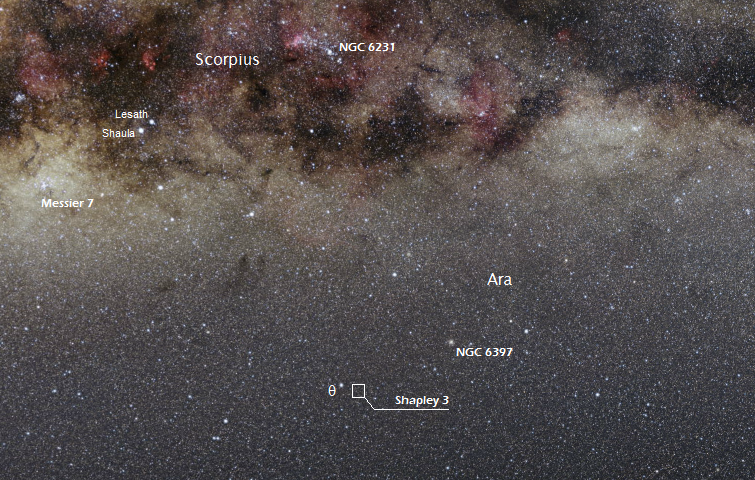
Position of the peculiar planetary nebula Shapley 3 in the winter southern sky.
Picture taken using the Photopic Sky Survey ©Nick Singer.


Figure 1. DSS image of Shapley 3. The gray circles on the image indicate areas of
brighter stars
Late August is a good moment to observe another remarkable planetary nebula, Shapley 3, which was first reported by Harlow Shapley in 1936. According to the book "Hartung`s Astronomical Objects for Southern Telescopes 2nd. Edition" by David Malin and David J. Frew, this planetary nebula is visible in an 8-inch telescope as a faint circular glow 30" wide. This object, also known as Hen2-341 and PK342-14.1, has a magnitude of 11.9 and a diameter of 36". To find this planetary is easy because it lies only 56 arc minutes to the south of the naked eye star Theta (θ) Arae (visual magnitude 3.7). If you can find NGC 6397 and enjoy the view of this nearby globular cluster, it can be useful to know that the planetary lies about 4.8 degrees northeast of it. 

Using the Optimum Magnification Methods and considering that a visual magnitude of 11.9 and an angular size of 0.6 arcmin are accurate values, the optimum magnification to detect this Milky way´s nebula is 100x for an 8-inch telescope working under a 6.2 limiting magnitude sky. So, let`s see what I could see at different magnifications from a site that offers not exceptionally dark skies but dark enough to carry out this kind of observation.

Figure 2. DSS image of Shapley 3 and its surrounding stars
At low magnification (42x) the field where Shapley 3 lies is rich in stars. Several of them are bright (around magnitude 9) for a telescope. In Figure 1 I indicate with circles the zones where the brighter stars lie. The zone between those mentioned areas shows not too many stars and all of them are faint. At this power, the stars linked with a blue line were used as a starting point to find the accurate position of Shapley 3. Without a doubt, this planetary is a challenging target for an 8-inch telescope. In spite of that, it can be barely glimpsed using averted vision as a quasi-stellar object, very small in apparent size. The very faint stars immediately surrounding this object can be also detected using averted vision, like the one indicated with the arrow in Figure 2 that was useful to find the accurate position of the planetary nebula. Using the Orion Ultrablock filter the planetary looks like a very small hazy spot. Averted vision is necessary to glimpse this faint object. With UHC the view is slightly improved. However, at this low magnification, the view is difficult appearing as a subtle and small hazy dot.

At 78x the faint neighboring stars are better viewed so it is easier to identify Shapley 3 in the field. Now the planetary nebula looks, even with direct vision, like a faint and small nebulosity surrounding a central star, which jumps to the view more easily when applying averted vision. With a UHC filter, the view is very different. It improves the view of the planetary a lot, appearing still faint but with a clear nebular nature, round, and rather smooth in brightness. For moments the central region appears brighter because of the presence of the central star. The view through the Orion Ultrablock filter is not so useful as that with the UHC filter. Shapley 3 does not appear so detached as with UHC. The central star is better viewed, always surrounded by subtle nebulosity.


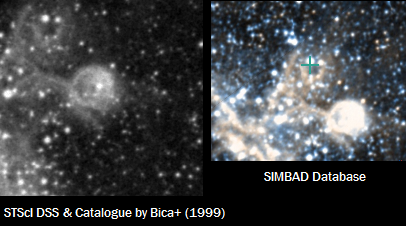
Shapley 3. Image from Simbad database
Higher power, like 106x, allows you to see the central star which is better detected using averted vision. This 12 magnitude star is surrounded by a very subtle nebulosity. UHC filter improves the view of this planetary nebula appearing as a round hazy spot of smooth brightness that can be identified from the surrounding stars. Dark adaptation is a must for an optimum view of this faint object. Using the Orion Ultrablock filter at this magnification the view did not depart from that without a filter. It was not as useful as the UHC in order to get a better contrast.

I got similar results after observing Shapley 3 with a little higher power (148x). However, the planetary appears even fainter, especially through the UHC filter. Orion Ultrablock offers a not so detached view of this object when comparing with UHC.


IC 4642

IC 4642 is a faint planetary nebula situated in constellation Ara, not so far from NGC 6397, one of the nearest globular clusters.
Picture taken using the Photopic Sky Survey
 ©Nick Singer.


IC 4642 ©R. Corradi et al.
For those observers who want to look for more challenging planetary nebulae with an 8-inch telescope, this one is an interesting target situated at the core of constellation Ara. IC 4642 (also PK 334-9.1) was discovered by Williamina Fleming in 1901. Some planetarium software, like Skymap for example, classifies this object as type 4 (ring shape in the Vorontsov-Velyaminov scheme). This planetary nebula is listed in the paper "Precessing Jets and Point-Symmetric Nebulae" by J.A. Cliffe et. al (1995) as having a bipolar/point symmetric symmetry. 

This 15" size object is immersed in a field that shows several faint stars. Some brighter stars are visible in the east half of the field of a telescope working at low magnification. In a 1-degree field, the brightest star is the 8.3 magnitude HD 154970. The stars linked with a blue line in Figure 1 are useful to find the planetary which forms a sort of "question mark" shape along with four faint stars of 11 and 12 magnitude (linked with pale blue lines on Figure 2 below). The 12 visual magnitude variable star V788 Arae, a semi-regular pulsating star according to the Simbad Database, is indicated in Figure 2 with a blue arrow. To use that asterism makes the identification of IC 4642 very easy. At low magnification (63x) and without any nebular filter IC 4642 is visible, appearing like a very small hazy disc that can be glimpsed even with a direct vision.

Figure 1
Averted vision, on the other hand, allows seeing a more detached view. A UHC filter improves the contrast at this power.

Jumping to a higher magnification (118x) the view of IC 4642 is more obvious at the eyepiece, clearly looking like a small, round nebulosity among the surrounding stars. Through a UHC filter, the view is definitively beautiful with the planetary detached against the background sky, rather smooth in brightness, and circular in shape. An Orion Ultrablock filter also improves the view, which is pretty similar to that obtained with the UHC filter but somewhat brighter through an 8-inch telescope.

This power (160x) makes the planetary to appear round and smooth in brightness. With averted vision the core of this object appears to look a little darker for moments, suggesting (in a rough way of course) a ring-type structure. Seeing conditions at the moment of this analysis was not the best, so it would be good to make another observation under more optimum conditions to compare results. The observation using the Orion Ultrablock shows a round and smooth nebula. Averted vision makes possible to detect what appears to be a point-like feature, slightly brighter, on its west side (indicated with a white arrow in Figure 2). It is important to say that this feature was very difficult to confirm.

Figure 2
At 222x IC 4642, round in shape, seems to show a somewhat darker core. However, this view is very subtle. Nebular filters, as in other cases, helped to show a more detached view of this planetary.