r .column-left-inner, column-left-outer { background: $(sidebar.bgl.color); } .column-right-inner, column-right-outer { background: $(sidebar.bgr.color); } .sidebar-right, .column-right-outer, #sidebar-right-1, .sidebar { background-color: #F5F7FA !important; padding: 15px; }

Translate / Traducir

Showing posts with label cumulos galàcticos. Show all posts

UGCA 334 - The Hardcastle`s Galaxy

OBSERVING REPORT

UGCA 334 - GALAXY IN CENTAURUS (THE HARDCASTLE NEBULA)

Date: February 9, 2016
Time: 01:30am local time (04:30am UT)
Telescope: 8" (20cm.) f/6.5
Observer: Leo Cavagnaro


Click on the image to enlarge
Finder Chart
13h 12m 56s   -32 41' 18" (J2000.0)


How to find it,
About 4°30' to the north-northwest of the 2.8 magnitude star Iota (ɩ) Centauri.
Stars in map up to visual magnitude 6.


Go to a good observing site and wait for sunset. Once you have very
dark skies aim your telescope to the north part of the constellation 
Centaurus to try to catch the Hardcastle`s Galaxy.
Photo taken by Leo Cavagnaro from the observing site.
If you are the owner of an 8-inch telescope or similar and want to observe this faint galaxy, just put your eye to work! Moreover, you need a very dark and steady sky to try to glimpse this "ignored galaxy". I say "ignored" because there is not too much bibliography and information about it taking into account that it is a target that several amateur observers can include in their observing projects. Well, maybe that has sense because there are much more interesting objects in the area where UGCA 334 resides like the big and beautiful galaxy Messier 83, situated about 6° east-northeast of it, or the less conspicuous but still interesting galaxy NGC 5102, which lies 4°5 southeast of UGCA 334, very close to the bright star Iota (ɩ) Centauri.

The Uppsala General Catalogue (UGC) is a list of galaxies published by Peter Nilson in 1973. It lists a total of 12,940 objects and is limited to the sky north of Declination -2°5. UGCA is an addendum of the Uppsala General Catalogue. According to Brian Cudnik in his book "Faint Objects and How to Observe Them" UGCA is a supplement that contains 444 objects of special interest south of the declination limit. However, I have found some UGCA galaxies with positive declination like UGCA 86 and UGCA 92 in Camelopardalis. UGCA 334, named "Hardcastle Nebula" by the SIMBAD Database and cataloged in that website as a "Galaxy in Cluster of Galaxies", is one of such objects. It is, undoubtedly, a faint galaxy, but it is bright enough to be seen with bigger telescopes that several observers usually have (e.g. 12, 18, 24-inch).

DSS image of UGCA 334. North is up.
I observed this galaxy in early February 2016, when constellation Centaurus reaches a good altitude around 1am local time and later, being visible just a few arc minutes of the zenith before sunrise.

UGCA 334 (also MCG-05-31-039, AM 1310-322, ESO 443-83), discovered by J. A. Hardcastle from the Franklin-Adams plates, reaches a very high altitude for any observing site at a latitude around -35°, so this part of the planet is perfect to try to see it. If you are as far north as +47° latitude the galaxy will be technically above the horizon, reaching about 10° when transiting the local meridian. However, I think this is not a good altitude to see a faint object like this one.

At least in projection, UGCA 334 lies very close to the galaxy cluster ACO 3544 (see map below) which appears listed in Table 4. Clusters of galaxies in the area of the Shapley Supercluster, in the paper "Structure and dynamics of the Shapley Supercluster" D. Proust et. al. 2006. However, I could not get enough information to find out if UGCA 334 is a real member of ACO 3544 or just a field galaxy. 

Using an 8-inch Newtonian telescope working at low magnification (42 and 78x) this galaxy was not visible. As a first step, I identified the pairs of stars indicated with blue ellipses on the image above. Observing carefully the area where UGCA 334 should be visible the result was unfruitful. Some ODM methods state that this galaxy, assuming that the magnitude value of 12.5 given by some sources is accurate, should be visible through an 8-inch telescope under a 6.6 limiting magnitude sky, being 107 the optimum magnification.

UGCA 334 and the core of the galaxy cluster ACO 3544 (green +) appear close to each
other in projection on the sky. 
Picture from AladinLite. Digitized Sky Survey - STScI/NASA, Colored & Healpixed by CDS
Applying higher magnification with one of my eyepieces (106x), and observing with averted vision under a dark sky, the galaxy could be barely glimpsed at times. It is a challenging object for a telescope of this size, so you need to stay at the eyepiece for some minutes and avoid even the polluted light of the site where you are observing from, by covering your head with a black cover. Try to be patient, even if the view is not clear you should see a very faint, small, very elongated, and smooth nebulosity. A ghostly image of a galaxy that looks like a lonely object in the southern sky.

The view of this galaxy with even higher magnification (148x) is similar, appearing smooth and elongated. It is a very challenging object, at least from my experience during that observing night.


Stellar Clusters in Messier 31

OBSERVING REPORT

G1 - GLOBULAR CLUSTER (DWARF GALAXY CORE?) IN ANDROMEDA GALAXY

Date: September 19, 2014
Time: -
Telescope: 20" (50cm) f/3.55
Observer: Leo Cavagnaro


Click on the image to enlarge
Finder Chart

How to find it,
About 2°40' to the southwest of the core of Messier 31

Stars in map up to visual magnitude 8
Deep-sky objects up to magnitude 13


The 100-inch telescope at Mt. Wilson.
Photo taken by Leo Cavagnaro.
Andromeda`s was the first extragalactic globular cluster system to be discovered (Hubble 1932). Hubble was able to distinguish Andromeda`s clusters on plates taken with the 100-inch reflector at Mount Wilson Observatory, California, USA. Since Hubble`s identification of 140 cluster candidates many authors have added to the list of cluster candidates.

The first detailed spectroscopic and photometric study of the cluster system was done by van den Bergh (1969) with the Palomar 200-inch Hale Telescope (see paper "Extragalactic Globular Clusters. II. The M31 Globular Cluster System" by John P. Huchra et. al. 1990).


This DSS image gives a clue about how you should see G1in a half a
degree field of view.
Also known as Mayall II, it was first identified as a globular cluster candidate by Mayall & Eggen (1953) using a Palomar 48-inch Schmidt plate taken in 1948. It was subsequently named G1 by Sargent et. al. (1977) in their survey with the Kitt Peak 4-m Mayall telescope of GCs in 29 fields surrounding M31 (see paper "Structural Parameters of Mayall II = G1 in M31" by J. Ma et. al. 2007).  G1 is the brightest globular cluster in the Local Group of galaxies. At a distance of 2.9 million light years it shines at 13.5 visual magnitude.

You must aim the telescope to a zone about 2.5 degrees to the southwest of Messier 31`s core to find it. Through a 20" telescope at 300x the cluster can be identified among two very close stars which form, with G1, a very small and tight equilateral triangle (look at the pictures). The globular cluster definitively looks non stellar at this power. Averted vision improves the view of it.

In the paper "Mayall II ≡ G1 in M31: Giant Globular Cluster or Core of a Dwarf Elliptical Galaxy?" (G. Meylan et. al. 2001), the researchers state that this globular cluster, like ω Centauri, has been considered as the possible remaining core of a former dwarf elliptical galaxy which would have lost most of its envelope through tidal interaction with its host galaxy.


_________________________


OBSERVING REPORT

C107 - OPEN CLUSTER IN ANDROMEDA GALAXY

Date: September 19, 2014
Time: -
Telescope: 20" (50cm) f/3.55

Observer: Leo Cavagnaro


How to find it,
About 29' to the southwest of Messier 32.


Position of C107 in Andromeda Galaxy (Messier 31).
With a magnitude of 15.1 and a size of 5.7 arc seconds this stellar cluster, situated not very far from the star cloud NGC 206 (about 7 arc minutes due south of this object), is clearly visible through a telescope of this size at 300x. Averted vision helps to get a better view. At this magnification it looks like a very small hazy spot immersed in the nebulous background produced by the Andromeda galaxy.


The Antlia Galaxy Cluster


Article published in the October 2011 issue of the Rosette Gazette newsletter (Rose City Astronomers, Portland Oregon USA)


Unveiling the Third Nearest Cluster of Galaxies
Observing its Brightest Members


Imagine yourself at a star party somewhere on the planet where the Southern Sky is visible, or at least the zone around -40° of declination is above the horizon. You will surely hear other observers talking about and planning observations of the most-known galaxy groups like those situated in Virgo, Fornax, or Perseus. If you are familiar with this kind of structure in the night sky, there is a good opportunity to add another cluster to your list carrying out an optical survey of a less known and fainter cluster, which will not be frequently mentioned in the observer`s world, the Antlia Cluster.

The constellation Antlia in the autumn sky. In the picture, I have labeled the stars of the constellation and some conspicuous objects in the vicinity, like the Eta Carinae nebula and NGC 5139 (Omega Centauri globular cluster). North is up. Image used with permission from the Photopic Sky Survey. Copyright Nick Risinger, skysurvey.org.

The literature states that this is the third nearest populous galaxy cluster in the whole sky, so I decided to carry out my own project to study this entity in detail using a common telescope and, like with other observing projects, have an empirical description of it, thus finding out how many and which members are in the range of an 8-inch telescope, getting conclusions and saving observations for other observers or for future new observations of this target.

The inconspicuous constellation Antlia, visible during the autumn months in the Southern Hemisphere, and composed of stars with visual magnitudes between 4.3 and 4.8, hosts this galaxy grouping situated 35Mpc away (about 115 million light-years), described as “a beautiful, small, nearby cluster of Bautz-Morgan type III” (Hopp & Materne 1985, Nakazawa et al. 2000) that is the third nearest galaxy cluster to us, inhabiting the eastern part of this constellation (see picture above).

Antlia cluster, also known as ACO S 0636, is centered at R.A. 10h 30m 01s  Dec. –35° 19' 35”. With a galactic latitude of 19°, it is not too far from the Zone of Avoidance (ZOA), a narrow band on the sky in which very few galaxies were found and cataloged, produced by the large clouds of gas and dust along the plane of the Milky Way.

I spent two nights observing the 1° field under analysis. The first night, the winter sky was amazingly clean, with very good transparency and very good seeing. This made possible to enjoy the starry sky with the naked eye and get the best view ever of the zodiacal light from the nearby site before starting with the observing project.

DSS image of the Antlia Cluster (1 degree field).
I began the observation with the cluster at 63° of altitude, at only 6 minutes of the ending of the local Astronomical Twilight. The first step was to identify constellation Antlia whose stars were visible to the naked eye. Once the constellation was identified, I focused on the region where the cluster lies. To make this possible it is necessary to fix our view on the eastern part of the constellation and identify the stars ι (Iota) and (α) Alpha Antliae that have similar brightness (visual magnitudes 4.6 and 4.3 respectively). Another “key” star to find the zone under study is the 5.3 magnitude HD 90132 which is also visible to the naked eye, appearing fainter than the other two (see map above).


The Core of Antlia Cluster

According toh F. Faifer et. al. in their paper “GEMINI-GMOS Spectroscopy in the Antlia Cluster” (2008), Antlia exhibits a complex structure consisting of several subgroups, the most important ones being dominated by the giant ellipticals NGC 3258 and NGC 3268, as it is indicated in the DSS image here.

The search of the field was made using 42x that offers a 1.12° field of view in my 8-inch telescope. The field of the core of the cluster was recognized observing a line of three stars indicated with a red ellipse in Figure 1 below, a chain of stars with visual magnitudes 8.6, 11, and 12.2. A sort of parallelogram, composed by some of the brightest stars in the field, was also identified. Actually, the star HD 91249 indicated with a blue arrow in Figure 1 (spectral type: K0III/IV) is the brightest in the field with a visual magnitude of 7.2. Other interesting feature there is an arrangement of stars that form a “Y-shaped” structure (indicated by blue lines in Figure 1). At this magnification, patches of diffuse nebulosity appear in the zone coincident with the positions of the galaxies NGC 3268 and 3267. A few other NGC galaxies populate the region, surrounding these galaxies.


NGC 3269
This member of the cluster is an SB0-a galaxy according to the Wolfgang Steinicke's Revised NGC and IC Catalog. At 42x, it was glimpsed using averted vision, appearing as a very small and faint patch of light. I could find the accurate position in the field using the stars enclosed by the gray square in Figure 1. With a magnitude of 12.3 and a surface brightness of 13.2 mag per square arc min it was hard to observe at this magnification.

At higher magnification (78x) it was more easily seen, appearing little elongated. Always averted vision was necessary.

Figure 1
In the paper “The Globular Cluster Systems of NGC 3258 and NGC 3268 in the Antlia Cluster” B. Dirsch, T. Richtler and L.P. Bassino state that this galaxy shows a compact absorption feature 4” in size that at the distance of NGC 3269 it would have a diameter of approximately 500pc. The existence of this dusty region in a galaxy which otherwise is devoid of gas and dust is by itself peculiar and it is an intriguing question whether this cloud is indeed in NGC3269 or whether it is a foreground object in the Galaxy.


NGC 3268 & NGC 3267
John F. W. Herschel discovered this object in 1835, an E2 galaxy according to the Wolfgang Steinicke's Revised NGC and IC Catalog. This 11.5 magnitude (SB: 13.8 mag per square arc min) member, who dominates the northern subgroup of the cluster, was visible with its close, fainter, and harder to see neighbor NGC 3267 (visible to the right of NGC 3268 in the picture here) applying averted vision. 

Appearing a little fainter than NGC 3271 which is (for me) the brightest galaxy in the cluster, NGC 3268 looked somewhat similar to that galaxy, showing a smooth brightness and round shape. This pair was better viewed at higher magnification (78x), with NGC 3268 being brighter and more easy to see. On the other hand, NGC 3267 requires a more detailed view and averted vision to improve the detection, looking smooth in appearance.

NGC 3271
Although faint, this SB0 galaxy (according to the Wolfgang Steinicke's Revised NGC and IC Catalog) was easier to detect and observe at 42x, appearing rather round and like a featureless small patch of light.
This 11.8 mag. SB: 13.6 (mag per square arc min) galaxy was observed at 78x when it was at an altitude of about 37°, appearing more obvious and sharper with its core looking a little brighter for moments. It is also catalogued as IC 2585.


NGC 3258 & NGC 3260
In the southwest corner of the Antlia Cluster core´s field we find NGC 3258, which is the dominating galaxy in the southern subgroup, an E1 type galaxy according to the Wolfgang Steinicke's Revised NGC and IC Catalog, with a magnitude of 11.5 and a surface brightness of 13.7 mag per square arc min. This galaxy, and its nearby companion, were visible through my 8-inch working at low power (42x) and using once again averted vision. Like the other members of the cluster, NGC 3258 and NGC 3260 look very faint and small. At 78x both galaxies were more clearly visible looking rather similar, showing roundish shape. NGC 3258 looked a little bigger and for moments appeared sharper than its companion. Both galaxies were discovered by John F. W. Herschel in 1834.

NGC 3273
Also catalogued as PGC1 30992, this SB0 galaxy (according to the Wolfgang Steinicke's Revised NGC and IC Catalog) was in the observing scenario. Being perhaps the faintest of the major galaxies in the cluster (magnitude 12.5 SB: 12.5 mag per square arc min) I could glimpse it for moments using averted vision when it was at an altitude of about 45°. Figure 1 shows, with a gray ellipse, some stars that were useful to find the zone where this galaxy lies. Even at 78x it was very faint but it is in a reach of an 8-inch telescope when the observation is made under good sky conditions.


Going Deeper, High Power Looking for Faint Members of the Cluster

Figure 2. Field of the Antlia Cluster. I have plotted with red squares the 
galaxies visually identified on a DSS image. Even more galaxies, very
faint and small, are situated in this field.
I spent the second observing night to scan the 1° field using 106x. The goal, to determine how many and which galaxies, visually identified on the DSS image and shown in Figure 2, were visible through an 8-inch telescope under the observing conditions that night. The disadvantage issue was the relatively low altitude of the cluster at the moment of the observation of these galaxies, (about 35°).

A short chain of faint galaxies, situated on the eastern edge of the field (middle left edge of the field, see Figures 1 and 2) was out of reach of my 8-inch telescope. Figure 3 shows the position of NGC 3258C, about 18 arc min east-northeast of NGC 3268. This SBa galaxy has a magnitude of 13.7, SB: 13.4 mag. per square arc min, and it was not visible in my 8-inch telescope. About 24 arc min to the east-southeast of NGC 3268 lies NGC 3258D, another challenging galaxy for an 8-inch mirror. This SBb galaxy was barely glimpsed. Its magnitude (13.2) and SB (13.4 mag per square arc min) explain why it was extremely hard to see it, just momentarily. An object with that magnitude and an angular dimension of 1.6 x 0.9 arc minutes (like NGC 3258D) should be visible in an 8-inch telescope under a 6.6 limiting magnitude sky according to the Optimum Magnification Methods.


Figure 3. Blue squares indicate the faint members of the cluster that were
under analysis during the observation through an 8-inch telescope. The 
galaxies in red were not visible.
When I observe the sky I have a motto, if you are doubtful about the visibility of any object that you are trying to see at the eyepiece field of your telescope, you must say “I didn´t see it”. This was the case with a seemingly very faint galaxy, LEDA3 83082, which lies about 6 arc min to the south-southwest of NGC 3268. Observing carefully in the position where this galaxy lies something appears to be there. If we are guided by data about the magnitude of this object (around 14.9) it is, without a doubt, a faint galaxy for an 8-inch telescope so maybe I saw the faint star immediately to the east (?). Another possibility is the fact that to be at the threshold of visibility played a trick on my eye. For sure bigger telescopes are necessary for detecting this faint member of the cluster and be sure it is visible for visual observers.

NGC 3257, an E/SB0 galaxy located about 3.5 arc minutes to the south-southwest of NGC 3258, has a magnitude of 13.1 and a surface brightness of 13.1 with an angular dimension of 1.0 x 0.9 arc min (Revised NGC Data). According to some ODM4 methods, this object should be visible through an 8-inch telescope under a 6.2 limiting magnitude sky. Observing carefully using 106x a very faint nebulosity could be glimpsed for moments using averted vision but a new observation using a bigger telescope would be useful.

Autumn in the Southern Hemisphere is the best season of the year to observe constellation Antlia and the cluster situated there. It is definitively a rather obscure target for observers with common telescopes but it is a good opportunity to aim our telescopes there and see deeper into our nearby universe.

_____________________________________________________________________________

1_ PGC Catalogue of Principal Galaxies. It constitutes the basis of the "Third Reference Catalogue of Bright Galaxies" (RC3). It lists equatorial coordinates for the equinoxes 1950 and 2000 and cross identifications for 73197 galaxies.

2_ FS90 is a catalog compiled by Fergusson and Sandage in 1990. They identified 375 galaxies within a projected area of 8 Mpc2 that are listed in the FS90 Antlia Group Catalogue.

3_ LEDA stands for Lyon Meudon Extragalactic Database. It has been the first Extragalactic Database. It was created in 1983 at Lyon Observatory. Since this time, the database has been continuously updated. The main idea is to collect raw measurements (coming directly from observations) and to archive them.

4_ ODM, Optimum Detection Methods. There is a good discussion in the Book “Visual Astronomy of the Deep Sky. Roger N. Clark, Ph.D. Cambridge University Press & Sky Publishing Corporation © Roger N. Clark 1990 First published 1990

Interacting Galaxies


Published in the January 2009 issue of the Rosette Gazette Newsletter (Rose City Astronomers, Portland Oregon USA)

The observation of galaxies, specifically compact groups, chains, and interacting galaxies are one of the most enjoyable and exciting activities for those amateur astronomers who carry out detailed observations. There are some well-known catalogs which list this kind of deep-sky objects. The Vorontsov-Velyaminov Catalogue of Interacting Galaxies, the Atlas of Peculiar Galaxies of Halton Arp, and the Shakbhazian Catalogue are some examples. Most of the galaxies included in them are only visible using telescopes with big apertures (18” or more).

Working at my desk, using software and articles I have in my computer, I was studying the southern sky centered at Right Ascension 22 hours and I found some interesting groups and chains of galaxies mostly situated in constellation Grus and also in constellations Pisces Austrinus (the southern fish), Sculptor, Phoenix, Sagittarius, Indus, Telescopium, and Pavo. I was reading the paper written by Arp & Madore “A Catalogue of Southern Peculiar Galaxies and Associations”, where galaxies from the South Celestial Pole to a declination of –22 degrees are cataloged in different categories according to the type of interaction.

This photo was taken by Jan Keiski at Paramillos, an observing site around 9,000 feet high in Los Andes Mountains where I went with a group of amateur observers to finish my observations. The picture shows constellations Grus, Indus, Tucana, and Pavo, the zone where the galaxies in these articles are situated. You 
can also see Venus (lower right) and the glow from Santiago of Chile (lower center) situated about 106 miles 
away in a straight line.


I made an observing program that includes a sample of galaxies that are visible in the spring southern sky. In this article, I have included my comments and reports about the observations, through my 8” telescope, of some of those galaxies. 

On Saturday, December 20, I had a chance to set up my telescope in a nearby observing site (Canota, -32° 34' / 68° 56' W) to begin the program. The summer solstice, for those who live here in the Southern Hemisphere, occurred on Sunday, December 21 at 12:04am UT, so that made for a short night for observing. The astronomical twilight (Sun is 18 degrees below the horizon) occurred at 10:26pm local time (01:26am UT). That night was clear but very warm even in the mountains. Hot wind and turbulent air in the atmosphere did not help much to have a good seeing, so I think I could get even better views of the faint associations and interacting galaxies I saw that night if I observe them again under a more steady sky. One week later, on Saturday, December 27, I went to Paramillos (about 9,000 feet above sea level) to finish the observations. From this last place, I observed the Pavo Group and a group of three galaxies in Grus. The region of the sky where these galaxies are situated was at low altitude because of the time of the year. I could not observe that region earlier this year because of bad weather during some New Moon weekends.


The Pair NGC 7232 / NGC 7233 and the Galaxy IC 5181 in Constellation Grus

Figure 1
Not too far from the bright star Al´Nair in the southern constellation Grus some galaxies, that are visible in the same 1-degree field of view, are found.

I began the observation at 11:20pm local time (02:20am UT) with the zone about 28 degrees high in the sky toward the west. The first attempt to observe these galaxies was using low power (42x). At that magnification, you can see an interesting starry field with some stars forming interesting shapes like the pair HD 211111 and HD 211121 (see Figure 1) that is useful to use as a guide to find and see the galactic pair close to it (NGC 7232 & NGC 7233). At this magnification IC 5181, a lenticular galaxy (S0), is the only galaxy I could see, appearing very small. 

At 78x I could improve the view. Now IC 5181 is visible showing an elongated shape and a very small and brighter core, as it appears in the DSS image of this object. Where the galactic pair lies, very close to the pair of stars of magnitude between 8 and 9, a very faint and little elongated hazy patch is visible using averted vision. The view was very difficult and it was impossible to discern the galaxies.

At higher magnification (106x) the galaxy IC 5181 looks interesting, with its bright core better viewed. The view of NGC 7232 & NGC 7233 is similar to the one I got with the lower magnification. NGC 7232A, the faintest of the four galaxies was not visible through my 8-inch telescope.


A Couple of Southern Quartets

Galaxy quartets in the southern skies
The Grus Quartet

In constellation Phoenix, R.A. 23h 18m 53s Dec –42°3, a small group of four galaxies resides. This is a good example of a galaxy quartet in the Southern Hemisphere. The brightness of its members makes possible to observe them properly with a small telescope like an 8-inch dobsonian. The first observation of this object was at local midnight when the group was 30 degrees high in the western sky. Using low magnification (42x) the galaxies are very well detected in the same field of view. All the galaxies show a smooth appearance and are elongated in shape. Three galaxies are very close to each other. Some arc minutes apart you can see NGC 7552 that also looks smooth and not so elongated.

Using a little higher magnification (53x) and observing in detail the group of three galaxies, NGC 7582, 7590, and 7599 (see picture above taken from Aladin v2 software) you can see that NGC 7582, an SBab galaxy according to the Revised NGC Data by Wolfgang Steinicke, is the brightest member. Starburst activity is observed in this galaxy and also in NGC 7552. A very few faint foreground stars are visible superimposed on the galaxy NGC 7590. On the other hand, NGC 7552, situated about half a degree southwest from the interacting triple, looks more round in shape and with a brighter core. 

At 106x the view of this galaxy is excellent. You can clearly see its bright and small core and also its elongated and smooth disk. The core is better viewed at 156x. Again at 106x, a 12.9 magnitude star is visible just on the border of NGC 7590, the smaller galaxy of the quartet. Some bright spots seem to be present in the elongated galaxy NGC 7582 when you observe it using averted vision. The galaxy NGC 7599 looks a little bigger and with a more smooth brightness.


The Robert´s Quartet. A Challenging Compact Galaxy Group

At the center of constellation Phoenix (R.A 00h 22m 00s Dec. -48°5 ), resides a small and faint group of four galaxies (i.e. NGC 87, NGC 88, NGC 89, NGC 92) discovered by John Herschel in 1830s and nicknamed “Robert´s Quartet” after the astronomer Robert Freedman who generated many of the updated positions of galaxies in the Arp & Madore Catalogue. It is about 160 million light-years from Earth and is a group of four galaxies included in the NGC catalog, NGC 87, NGC 88, NGC 89, and NGC 92. It is classified as a category 4 “Interacting Quartets” in the Catalogue of Southern Peculiar Galaxies and Associations by H. Arp, B. Madore and W. Roberton (Cambridge University Press). I used a bigger telescope to observe this group, a 16-inch telescope working at 72x.

The Robert`s Quartet
To find this group was not easy because the galaxies are very small and faint. As shown in the eyepiece field picture (Figure 2) I used some stars to recognize the zone where this small group lies. The triangle of stars with magnitudes between 10.7 and 12.5, indicated with a red circle in the eyepiece field, is easy to identify and it is useful to use as a guide. Also, the chain of three faint stars to the left in the field (also indicated with a red circle) was useful to find the extremely faint PGC galaxy.

Figure 2
Some members of the quartet are visible, NGC 89 and NGC 92. They are the brightest members with magnitudes 13.3 and 12.9 respectively. They look faint even in a telescope of this size, like round and fuzzy clouds of smooth brightness. Being not a member of the group, the faint galaxy PGC 1452 is barely visible with averted vision like an irregular and smooth patch.


Two Superb Cases in Constellation Pavo

NGC 6769/6770/6771 is a good example of an interacting triple, with three galaxies of any type which appear disturbed.
This group is very low in the southwest sky from here in December so I will observe it in detail in the coming months and will include it in the second survey of this zone of the sky next year.


The Pavo Group

The Pavo Group
NGC 6876 E3 Galaxy Magnitude 10.7
NGC 6877 E6 Galaxy Magnitude 12.2
NGC 6880 SB0-a Galaxy Magnitude 12.3
NGC 6872 SAB(rs)c Galaxy Magnitude 11.7

In the eastern part of the southern constellation Pavo (Peacock), about 180 million light-years away, you can find an interesting group of galaxies named the Pavo Group. NGC 6876 (an E3 galaxy) and NGC 6872 are the dominant members of this moderately massive and dynamically young group (see the paper: “A Multiwavelength View of Star Formation in Interacting Galaxies in the Pavo Group” by M. Machacek et. al. published in The Cornell University e-library on October 20, 2008).

Observing this group with an 8-inch reflector working at low power (42x) the most prominent galaxy is the elliptical NGC 6876. Situated in a relatively rich starry field, it looks small and shows an increasing brightness toward its center. At this magnification, the galaxies NGC 6872 and NGC 6880 are very hard to see. They are barely visible using averted vision, like small and fuzzy patches.

Using higher magnification (78x), NGC 6876 looks a little elongated and may have an irregular shape. To the East, NGC 6880 is better viewed showing a smooth brightness. NGC 6872, a gas-rich spiral galaxy, forms a tidally interacting pair with the spheroidal companion IC 4970 (indicated with an arrow in the picture above and visible only in bigger telescopes). This pair is the VV 297 object (Vorontsov-Velyaminov). NGC 6872 is seen very close to the star of magnitude 10.4 TYC 9311-418-1. This faint galaxy also shows a smooth appearance.

In the picture, North is up.
I observed in detail the main galaxy NGC 6876 using higher magnification (148x). On its southeast border, a star is clearly visible. This galaxy shows a little brighter inner part. Observing with averted vision, a star-like brightness much smaller than that shown in the picture to the right is visible for brief moments inside the most prominent part of the galaxy. The star-like brightness and the star on its border are indicated with arrows.

At first glance, the small galaxy NGC 6877 (to the left in the picture) was not visible. However, a more accurate observation made possible a glimpse of a very small, round (in spite of its classification as E6 galaxy), and faint cloud.


Another Galaxy Group in Grus

There is a group of galaxies in the southern constellation Grus, not too far from the pair NGC 7232/NGC 7233. That group is listed in the paper “Dynamics of the Pavo-Indus and Grus Clouds of Galaxies” by P. Fouqué et. al. The brightest members of the group are NGC 7162, NGC 7162A, and NGC 7166. However, they are faint targets for an 8-inch mirror working at low magnification.

Figure 3
To find the field where these galaxies lie was easy because you can see an asterism of four stars (red circle in Figure 3). They are actually the brightest stars in an eyepiece field poor in stars. Once in the field, NGC 7166 is found without a problem using the line of three stars indicated with the red line. It was possible to glimpse this galaxy at low magnification (42x), appearing very small and faint.

Using the same eyepiece and a barlow lens, thus reaching higher magnification (83x) NGC 7166 is easily seen, appearing more elongated and with a bright stellar-shape core. NGC 7162 is barely visible but it is there if you observe it carefully with averted vision.


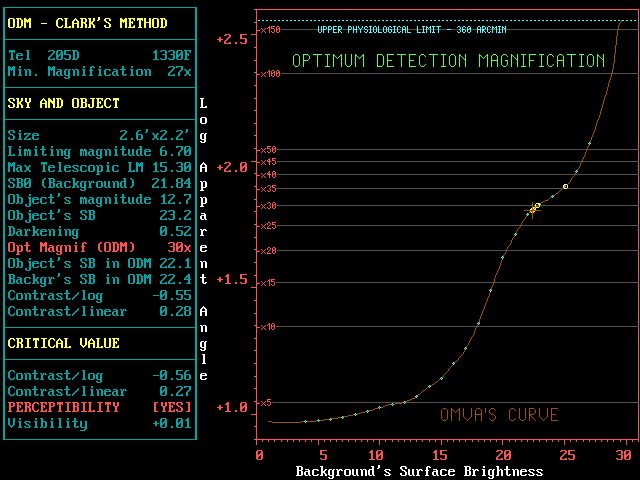
Applying Optimum Detection Magnification Methods

I tried to observe the very faint galaxy (at least for an 8-inch telescope!) NGC 7162A. It is a galaxy of morphological class SBm. Its magnitude is 12.7 and its surface brightness jumps to 14.4. It was not visible through my telescope. The day after observing I was working on the application of Clark´s Method of Optimum Magnification to this case (the galaxy NGC 7162A). According to this method, this galaxy should be visible through a telescope like mine (8-inch) under a 6.7 limiting magnitude sky. There exist another method called “Size and Contrast”. According to this one, we also need a 6.7 limiting magnitude sky to get a view (in theory) of NGC 7162A. I don´t know if these methods take into account the altitude in the sky of the target as one of the main factors. I tried to observe NGC 7162A under not favorable conditions (low altitude). I will try again next year when this galaxy is higher in the sky and from a very dark sky site.