Published in the April 2013 issue of the Rosette Gazette newsletter (Rose City Astronomers, Portland Oregon USA)
Bright Emission Nebulae and a Supernova Remnant
are Found in the Northeast Region of our Satellite Galaxy
The sky is getting darker at Uspallata Valley1, in
central-west Argentina. Slowly, the Magellanic Clouds become visible in the
Southern Sky. Hidden not too far from the heart of the Large Magellanic Cloud
(LMC) an interesting complex of small nebulae resides. The question arises,
how much you can see there with a common 8-inch telescope? Is this area of that
galaxy impressive enough to observe and study with this kind of optical
instrument?
I have tried to describe in this article all the
details you can observe in this complex, in fact, one of the most interesting within our
satellite galaxy.
 |
The Southern Sky in summer. The Large Magellanic Cloud (right on the picture) is an astounding unaided eye object, together with the Eta Carinae Nebula (upper) and the Coalsack Nebula (middle left). Photo by the author.
|
I spent two nights, March 8 and 9 (2013), to observe a small region centered at R.A. 05h 39m Dec. -67° 40', which corresponds to the “area 24” of my big observing project about this galaxy. Using an 8-inch telescope and an eyepiece that gave me 37x and a wide field I got a first view of the zone. At that moment, the galaxy was 48° above the horizon. The stars in the field mostly have visual magnitudes fainter than 11. The star HD 38616, with a visual magnitude of 7 (Figure 1), is the brightest one there. On the west edge of the eyepiece field, a nebulae complex is easily visible even without filters. It is, by far, the most conspicuous feature in the field.
The N59 Nebula
 |
Figure 1. The region under observation is situated to the north of 30 Doradus
(Tarantula Nebula). North is up.
|
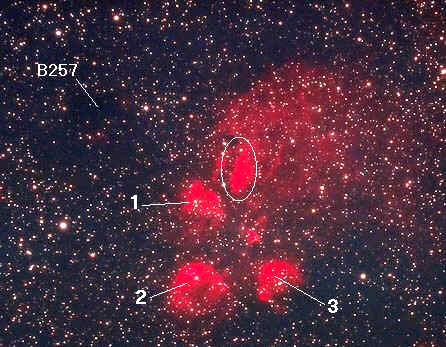
Focusing on this complex, three patches are visible at 37x. The brightest and biggest zone, known as N59A (see Figure 2), exhibits the shape of a fan with several filaments which may be ionization fronts, thus making it the third brightest nebula of the LMC after 30 Doradus and N11. It is composed of two regions or maybe just one big region elongated roughly west-east with a dark lane across dividing it into two parts of similar brightness. These two parts have NGC numbers, 2035 and 2032. The first one was discovered by James Dunlop in 1826. The other one, NGC 2032, was observed by John F. W. Herschel in 1834 but surely Dunlop observed it too because it is very similar to the other area discovered by him. “The dust lane seems to be mixed in with the nebular gas and the stars, suggesting a site where star formation may still take place. However, from the morphology revealed by those direct images, it is impossible to ascertain whether those nebulae are physically related or even, whether they are located at the same distance” (extract from the paper “Kinematics of the very young nebula N59 at the edge of the supershell LMC-4” M. Rosado et. al. 1998). N59A is closely related to the OB association4 LH 825, which covers an area of 3´x 6´ and virtually coincides with the nebula.
 |
Figure 2. N59 complex. North is up
|
At 48x, the view is more detailed. In the brightest area divided by the dark lane, the eastern patch (NGC 2035) looks slightly smaller while the western patch (NGC 2032) appears bigger, showing two stars at its western edge. An extension of fainter nebulosity, which becomes narrower toward the West when seen through an 8-inch telescope, is visible at this power. I am speaking of NGC 2029 (see Figure 2). On the other hand, NGC 2040 was clearly seen, fainter than the other patches and with smooth brightness. With averted vision, a very small spot seems to lie very close. Maybe the two stars in the region of the supernova remnant? Read more below in this article.
Applying higher magnification (64x) I got a beautiful view of this complex. NGC 2032 and 2035 look very bright. Although both nebulae together are slightly elongated west-east, NGC 2032 specifically is a bit elongated north-south. Even if the overall shape of NGC 2040 is round, at this magnification some clues of irregular shape appear. The small and faint region known as N59C (see Figure 2) could not be visible at this magnification.
In the second observing night I applied UHC filter to this eyepiece to observe this complex. I started the observation at 10:35pm local time (UT-3hours) with the Large Magellanic Cloud at 47° of altitude in the sky. The view was very clear, with the patches NGC 2032 and 2035 obvious in the eyepiece. NGC 2029 is visible as a smooth nebulosity while NGC 2040 is more easily visible than the view with the other eyepieces. Through this filter, it looks slightly fainter than NGC 2032/35. With averted vision, a bright dot is visible within the nebula, maybe a star member of the OB association LH88 associated with NGC 2040. This filter improves the overall view of the complex, being especially useful for a better view of NGC 2029 that shows a triangular shape, getting narrower outwards of the brightest part of the complex. Although it was difficult, the view of N59C, a small, round, and faint nebulosity in the southeast part of the pair NGC 2032/2035 was possible at this power using this kind of filter.
Through an Orion UltraBlock filter N59 looks very well. Like the UHC filter, this one improves a little the view of the whole complex. However, it can be observed without a filter as well. This filter helped for the observation of the two faint nebulae NGC 2029 and 2040.
I spent most of the second night (March 9) observing these nebulae with higher magnification. At 120x, the view of N59 is more interesting and detailed. Each region or patch is clearly visible and identified. NGC 2040, which shows a similar brightness to NGC 2029, and fainter than the two main patches, shows some faint stars embedded in the nebulosity. It is surely the aforementioned OB association LH88 (Lucke & Hodge 1970).
Aiming the telescope to NGC 2032 & 2035, both nebulae look outstanding at this power. NGC 2035 looks round while NGC 2032 appears a bit elongated. C. Armand et. al. point out that the main star that excites the region N59A is an O5 spectral type they name “star 226” in their paper. I indicate it in Figure 2 with a small red circle. The detached black lane between the bright nebulae adds an interesting view to the region. NGC 2029 looks faint at this magnification, being better viewed using averted vision.
 |
Figure 3. The [S II] emission (yellow) defines the supernova
remnant. Picture from Smith et. al. 1999. North is up.
|
An Extragalactic Supernova Remnant
A supernova remnant, known as SNR 0536-676, is situated in this complex. It was identified as such by Mathewson et. al. (1985). It appears to be a blow-out of the dense HII region N 59B around the OB star association LH 88 (Chu & Kennicutt, 1988).
I invited my friend Carlos Gutierrez to observe this elusive object using a 16-inch telescope. A first observation at 106x made possible to identify two very faint stars situated in a key position to try to delineate the shape and size of the supernova remnant. They are indicated with the red arrow in Figure 3. After that, we tried to see some nebulosity in the region immediately to the South and West of NGC 2040. However, it was impossible to view at this magnification and under the observing conditions that night. Using a UHC filter with this eyepiece, an extremely faint, elusive, and small nebulosity could be glimpsed in the region indicated by the ellipse in the picture, which is coincidental with the brightest portion of the supernova remnant. The view was very difficult and it was close to a “retinal torture”.
This elusive nebulosity is also visible in the DSS image in Figure 2. There it looks a little brighter than N59C but it was harder to see even through this bigger telescope. The nebulosity labeled with the square in Figure 3 was also visible using averted vision for both of us. Carlos stated that it has a triangular shape, narrowing toward NGC 2040. According to the picture, this nebulosity seems to be not a part of the supernova remnant, but an extension of the NGC 2035 region.
At 144x, the two stars are clearly visible and another star (to the North) is also detected. The small patch close to the stars is visible for some moments. The zone enclosed by the square shows a faint star within (visible in Figure 3). With a UHC filter, the view is similar to that at 106x.
This elusive nebulosity is also visible in the DSS image in Figure 2. There it looks a little brighter than N59C but it was harder to see even through this bigger telescope. The nebulosity labeled with the square in Figure 3 was also visible using averted vision for both of us. Carlos stated that it has a triangular shape, narrowing toward NGC 2040. According to the picture, this nebulosity seems to be not a part of the supernova remnant, but an extension of the NGC 2035 region.
 |
Figure 4. N70 nebula. North is up
|
The N70 Nebula
Also known as DEM L6 301, it is one of the most outlying bright emission-line objects, located in an isolated region of the disk, far from supergiant shells (Meaburn 1980), H II regions, and bright diffuse H-alpha emission, a textbook example of an isolated superbubble. “It is an especially prominent bubble of line-emitting gas which appears to be powered by a population of hot massive stars in its interior” (paper, "Emission-Line Properties of the LMC Bubble N70", B. Skelton et. al. 1999). To observe this object you need a very dark sky, good dark adaptation, and patience to detect the faint nebulosity situated 45 arc minutes to the southeast of N59.
 |
Figure 5. The cluster NGC 2053 (left). North is up.
|
At 48x, I could clearly identify the double star. Observing in the area of this nebulosity, a very small and compact stellar group is detected where LH 114 lies. This compact group appears surrounded by a faint and smooth nebulosity, N70.
At 64x, in the central zone within the faint nebulosity, a sort of “defocused star” can be glimpsed. For a moment, and using averted vision, 2 or 3 stars very close to each other seem to lie in the zone. At this magnification and using a UHC filter, N70 looks a little more detached from the surrounding sky, but it is a very faint object. Averted vision suggests its round shape, showing a smooth and faint brightness. At the center of the nebulosity, the small region slightly brighter is easily distinguishable.
Through an Orion UltraBlock filter, the view is very similar. The stellar nature or content of the small central region embedded in nebulosity can be confirmed.
How does N70 look using 120x? Well, the stellar configuration mentioned above is easily identified in the eyepiece field and the faint nebula can be glimpsed, showing smooth brightness and engulfing the stars there. LH 114 appears like a small and compact stellar group, and some members can be spotted using averted vision. The view with a UHC filter is not very different.
In the outskirts of the complex N59, to the northeast, two small hazy spots are visible. Averted vision helps to see them better. According to the DSS image one of them, indicated with a red arrow in Figure 5, is a group of 3 stars surrounded by faint nebulosity. At low power (37x) and using averted vision it looks nebular and a little elongated, suggesting the 3 stars in a raw. Higher magnification is necessary to see it in detail. I personally don´t know if these stars are members of the OB association LH 92. I could not find detailed information about this association, but the DSS image obtained from http://archive.stsci.edu/cgi-bin/dss_form shows the area of the three stars as the place of LH 92. The other one is the open cluster NGC 2053 (see Figure 5) discovered in 1837 by John Frederick William Herschel, an object with a magnitude of 12.2 according to the NGC/IC Project web page and the Wolfgang Steinicke's Revised NGC and IC Catalog. The zone of the two objects seems to be connected with faint nebulosity. The three stars are in the region known as DEM L 250. The DSS image of this nebula shows the three stars at the center.
At 48x, the three stars are better viewed very close to each other. NGC 2053 looks, with averted vision, as a small hazy spot of smooth brightness. I got the same view of this open cluster at a little higher magnification (64x), appearing round in shape. At 120x, this cluster looks faint but appears relatively big in the field of this eyepiece. Averted vision improves the view. At this power, the three stars were clearly visible and no nebulosity was glimpsed there.
At 64x, I saw a “star” that looked faint and surrounded by a kind of very small nebulosity, appearing as a defocused star. You can see it does not show the point-like appearance of the stars if you compare it with the nearby (only 2.5 arc minutes away) 9.3 magnitude star HDE 269804. Observing this area with 120x, I could see a very small group of 2 or 3 stars very close to each other. Later, when I checked the DSS image, I identified the three faint stars on the picture (see the small panel on the right hand of Figure 5).
Once again, I am amazed how small details and faint objects can be observed with an 8-inch telescope when they are carefully observed using good charts, deep-sky images (DSS for example), and having a peaceful and dark place to observe from.
_________________________________________________________________________
1_ It is situated about 75 miles to the west of Mendoza city, in Los Andes mountains. It is a good place to observe the skies. Geographic coordinates, 32° 36´ 32” S 69° 21´ 18” W.
2_ LHa-120 N- This is the full name of an entry in the Henize catalog of LMC emission nebulae. "L" refers to the Lamont-Hussey Observatory of the University of Michigan; "Ha" means the Hydrogen-alpha emission line, the key signature line used in the survey; "120" refers to the plate number (objective prism plate) for the LMC; "N" labels the object as a nebula, as distinct from a star (label "S").
3_ LMC4 is a kpc-sized ring of H II regions in the Large Magellanic Cloud.
4_ OB Association: The concept of a stellar association was originally introduced in 1949 by V. A. Ambartsumian, who later separated them into OB and T associations (Ambartsumian 1968). Morgan, Sharpless, & Osterbrock (1952) considered as a stellar association any loose group of stars within an area where bright OB stars exist and with evidence of a common origin.
A recent definition of a stellar association (Kontizas et al. 1999) refers to it as a single, unbound concentration of early-type luminous stars, embedded in a very young star-forming region.