

Some Fascinating Planetaries Inhabit
the Constellations of the Winter Southern Skies
Part I. Bipolar planetary nebulae
A winter starry night anywhere in the Southern Hemisphere shows a region in the sky, between Right Ascension 12 and 19hs, where some constellations like Crux, Centaurus, Norma, Ara, and Sagittarius host some interesting planetary nebulae. The four planetaries included in part I of this article have a common morphology, all of them are so-called "bipolar planetary nebula". Bipolar planetaries is one of the five types in the morphological classification by Schwars et. al. (1992), i.e. Elliptical (e), Bipolar (b), Point symmetrical (p). Irregular (i), Stellar (st).
If you have at least an 8-inch telescope all of the planetaries mentioned in this article are visible. Of course, you will be able to find more features or analyze their morphologies in more detail if you observe them through a bigger instrument.
The Boomerang Nebula
 |
| The Boomerang Nebula © APOD |
If you look for this object, do not be confused by another object with the same name, the interacting pair of galaxies ESO 296-11 (also VV 578), situated in constellation Phoenix and showing a V-shaped structure.
A good way to find the peculiar Boomerang nebula is to look for the well-known constellation Crux (the Southern Cross) and use one of its bright stars, Gacrux (visual magnitude 1.6), as a starting point (see map below).
Another useful star is magnitude 3.5
μ (Mu) Crucis which is, in fact, a nice double star to see. The target forms with this star and Gacrux a roughly equilateral triangle, so having this in mind you can aim your telescope to the precise area to scan and identify it.
I observed this object using an 8-inch reflector telescope, with the zone under study high in the sky (about 53°) in the first hours of a clear and steady winter night. At low magnification (42x) the 1-degree field shows the brightest stars grouped in the west side of it (see Figure 1). The pair of stars and the Y-shaped pattern indicated with blue ellipses helped to confirm that I was in the correct zone to find the nebula. Even at this low magnification, the nebula is within the reach of an 8-inch telescope, which surprised me. However, it was barely glimpsed using averted vision. Pay attention to the center of the field, I have linked there some stars I used to reach the accurate position of "Boomerang". This nebula forms, with other three stars, a sort of "trapezium". The proto-planetary looks very dim, like a small hazy star or spot. This is one of the many objects in the sky that can be overlooked if you scan the region at low magnification without a detailed chart because it does not look very different from the surrounding stars that populate the field. Two very faint stars are situated very close to the proto-planetary. This should be taken into account when we use low magnification because maybe we are detecting the glare of these stars along with the dim nebula. Higher power will tell us if we can discern the Boomerang nebula from these cosmic neighbors.
A UHC filter does not help to improve the view of this small and faint object. In fact, I could say that the view is a little worse than that without the filter.
The view through the Orion Ultrablock filter is a little better than that of the UHC and similar to that obtained without filters.
Another useful star is magnitude 3.5
 |
| ESO 296-11, an interacting system |
 |
Although the Boomerang Nebula is situated in constellation Centaurus, you can use constellation Crux as a guide to find this mysterious object of the Milky Way. Picture taken using the Photopic Sky Survey ©Nick Singer.
|
 |
Figure 1. The proto-planetary nebula as seen in a 1 degree field of view.
North is up. |
A UHC filter does not help to improve the view of this small and faint object. In fact, I could say that the view is a little worse than that without the filter.
The view through the Orion Ultrablock filter is a little better than that of the UHC and similar to that obtained without filters.
At 78x the view becomes more interesting with the nebula more clearly visible using averted vision. For moments, it is visible with a star-like appearance with a small and faint hazy envelope.
The pair of very faint stars (for an 8-inch telescope) can be barely glimpsed. At this magnification, the nebula can be discerned from the nearby stars (see Figure 2). The UHC filter at this magnification is not useful to improve the view of the object under study. On the other hand, the Orion Ultrablock filter worked in a similar way of that at lower magnification being a little more useful than the UHC filter.
Even if the proto-planetary is a faint object it is visible even with direct vision at 106x. The nearby stars can be discerned and Boomerang looks like a faint star surrounded by a small nebulosity. Its elongated shape, evident in photographs, is not visible through an 8-inch so far. The result of using nebular filters (UHC and Orion Ultrablock) is the same as that at lower magnifications.
At 196x, the view is interesting as well. The nebula appears faint but its nebular nature is clear. It looks rather smooth in brightness and its bipolar shape could not be seen.
Menzel 1
Look at the map above. This peculiar planetary nebula (also known as PK322-2.1) is situated in the southwest corner of constellation Norma, almost on the border with constellation Circinus. Menzel 1 is situated only a few arc minutes apart from the stars ɤ and β Circini (visual magnitudes 4.5 and 4.1 respectively) so you can use them as a starting point to find the planetary among the stars. According to the paper "Three-Dimensional Photoionization Structure and Distances of Planetary Nebulae. II. Menzel 1" by Hektor Monteiro et. al. 2005), Menzel 1 or G322.4-02.6 (R.A. 15h34m 17.002, Dec. -59° 09.05, [J2000.0]) is a bright object with a bipolar morphology and a prominent central ring of enhanced emission.
At low magnification (42x) a field rich in stars is visible. This is understandable if we consider that this object lies in a region of the sky at low galactic latitude (approx. b=2.5°). The asterism labeled with a red ellipse in Figure 3 was very useful to find the accurate position of this planetary nebula that is almost unnoted among the big number of the Milky Way`s stars seen in that line of sight. Menzel 1 is barely visible at this low magnification appearing faint, round in shape, and smooth in brightness. The UHC filter undoubtedly enhances the contrast of this planetary nebula, showing the same features mentioned above.
The view through the Orion Ultrablock filter improves also but the contrast is not so good like that obtained with the UHC filter.
At 78x Menzel 1 is seen more easily, rather round in shape and with a smooth surface. However, it looks sharper through a UHC filter. For moments, using averted vision, a point-like feature seems to be visible within it. The view also improves using the Orion Ultrablock filter with the nebula appearing rather round and smooth in brightness.
At 106x the planetary is visible even with direct vision like a smooth and round disk. At
this magnification the planetary looks very detached when using a UHC filter being pretty obvious in the field of view. Using averted vision, a few brighter dots seem to be visible within Menzel 1. The view with the Orion Ultrablock at this power is similar.
An analysis of this object using 266x makes it possible to see, for moments, small brighter zones inside the rather smooth in brightness planetary Menzel 1. Using the Orion Ultrablock filter, the planetary appears to show a very slight oval shape.
Menzel 2
This small and faint planetary nebula (also PK 329-02.2) is hard to see through an 8-inch telescope when you scan the field at low magnification (e.g. 42x). Situated about 21 arc minutes southeast of the 5 magnitude star κ (Kappa) Normae (see map above) which is, in fact, the brightest star in the 1° field of view centered in the object under study, Menzel 2 is barely glimpsed at the mentioned low power in a field rich in faint stars. You can move the telescope that angular distance to find the target or you can also use a group of faint stars, linked with blue lines in Figure 6 below, to find it.
According to the book "The Physics and Dynamics of Planetary Nebulae" (Grigor A. Gurzadyan 1997), Menzel 2 is bipolar and also has two envelopes, and furthermore, there are traces of spiral structure on the second envelope. The planetary, about 7,700 light-years distant, lies between the stars TYC 8715-1172-1 and GSC-8715-1518 (visual magnitudes 10.3 and 10.9 respectively), appearing like an extremely faint and very small nebulosity when you observe it using averted vision.
The use of a UHC filter improves a lot the view and therefore its detection. I used the "Blinking" method to notice how Menzel 2 jumps into view when you use this nebular filter. The appearance through this kind of filter is very contrasted looking like a small, round, and smooth patch. The Orion Ultrablock filter also improves the view but it is not as good as that achieved with the UHC filter.
Higher magnification (e.g. 78x) makes the detection of the planetary easier. At this power, it is visible even with direct vision and without a filter. However, to use averted vision improves its visibility. With the UHC filter and this magnification the view of the planetary es clear. I should say that it is a good power and filter to have a good view of Menzel 2. It is obvious among the stars in the field, even with direct vision, appearing round and smooth in brightness. A similar view is achieved using another filter, the Orion Ultrablock.
It is named after the astronomer Donald Menzel who discovered the nebula in 1922. The nebula forms a winding blue cloud that perfectly aligns with two stars at its center (see Figure 5).
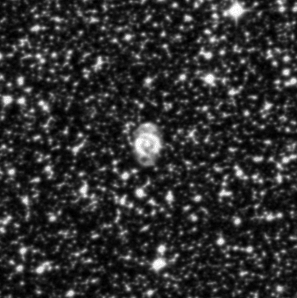
106x makes possible to see the planetary easily, appearing round. Observing carefully using averted vision the rim of the planetary nebula seems slightly brighter, suggesting an annular shape. The DSS image of Menzel 2 shows a bright rim, giving an annular shape to the inner part of this planetary. Actually, the V-V classification for this planetary is 4(3). Through the UHC filter, its eastern edge (left in Figure 7) seems to appear slightly brighter, showing the planetary nebula some trace of ring structure.
A nebulosity with a darker central area is visible at 266x.
Hubble 5
This object is situated on the border between constellations Sagittarius and Scorpius, about 1° from the galactic center. Hubble 5 is the fourth bipolar Planetary nebula – after NGC 7026 (Gruendl et al. 2006), the transitional
object NGC 7027 (Kastner et al. 2001), and the possibly symbiotic system Menzel 3
(Kastner el al. 2003) – with suspected diffuse X-ray emission and only the second Type I
PN is known to display X-ray emission (paper "Serendipitous XMM-Newton Detection of X-ray Emission from
the Bipolar Planetary Nebula Hb 5", Rodolfo Montez Jr. and Joel H. Kastner 2009).
According to J. A. Lopez et. al. in their paper "Morpho-kinematic analysis of the point-symmetric, bipolar planetary nebulae Hb 5 and K 3-17, a pathway to poly-polarity" (2012), this planetary shows a tight waist with a bright core. From the core emerge a complex set of filaments distributed as in a rosette configuration. For Hubble 5 some of these filamentary loops are proven for the first time in this work to actually be secondary expanding lobes. The nebular nucleus of Hubble 5 is very complex.
As a consequence of staying close to the galactic center, immersed in the band of our Milky Way (see map above), the field shows a big amount of stars, mainly faint. That is the view I had at low magnification, with a field showing no asterisms or distinctive patterns of stars that can help to find the accurate place where Hubble 5 lies.
Even if you can use the naked-eye star 3 Sagittarii as a guide to find Hubble 5, you can also use a rich open cluster situated not too far from it. This cluster is nicknamed "Tom Thumb Cluster" (NGC 6451). Due to it is the most conspicuous object in the vicinity of Hubble 5, you should know that this planetary nebula lies just 39 arc minutes to the northwest of this stellar swarm, in case it unexpectedly be found first. Thus you can use it as a starting point to jump to the target.
There exists an HII region in the Local Group galaxy NGC 6822 which is known as Hubble V. Be sure to avoid troubles if you try to find a DSS image of the planetary nebula using the DSS-MAST-STScI web page. It will show a picture of that extragalactic HII region, at least you put "PN Hubble5" in the search box.
At 42x, Hubble 5 can be glimpsed. However, it is "hidden" among the surrounding stars of similar brightness, so that its identification is a little difficult. A good sky chart and a detailed field of view showing the surrounding stars is a must to get success searching for this planetary nebula. The blinking method, using a couple of nebular filters, was a good way to see Hubble 5 standing out among the stars at this low power.
At a little higher magnification (78x) the view is more clear and easy. Although it looks rather stellar in appearance, some of nebulous appearance starts to appear (faint star surrounded by subtle nebulosity). Using a UHC filter the planetary nebula is better viewed. A similar result was achieved using the Orion Ultrablock filter, offering a sharper image of Hubble 5.
106x. At this magnification the planetary nebula is clearly visible even without a filter, appearing very slightly elongated and rather hazy in appearance. When Hubble 5 was seen using averted vision, two faint dots come into view, very close to each other and embedded in some nebulosity. At this power, the UHC was more useful than the Orion Ultrablock filter to improve the contrast of the target through the 8-inch telescope.
A final observation at 148x made possible to see the very tight pair of stellar features or dots. One of them is brighter. In the paper "The Complex Ionization Structure of the Planetary Nebula Hubble 5" Angels Riera et. al. (2000), the researchers state that there is a blow-up of the core region and no central star is observable, though ionization gradients all "point" to the dense center of the core. After checking the blue filter image provided by the STScI Digitized Sky Survey, the appearance of the planetary nebula through that filter is exactly the same I had of the planetary nebula, with the two starlike features (see lower panel in Figure 10). The brighter dot I saw seems to be the bright core visible in the colorful picture in Figure 8. Not too many details can be visible through an 8-inch telescope in small objects like this one. Surely, a more detailed report will be achieved in the future using a bigger telescope.
_______________________________________________________________________________________________________________
1_ A protoplanetary nebula or preplanetary nebula (PPN) is an astronomical object which is at the short-lived episode during a star's rapid stellar evolution between the late asymptotic giant branch (LAGB) phase and the subsequent planetary nebula (PN) phase.
 |
| Figure 2. DSS image (15`x 15`) of the Boomerang Nebula |
Even if the proto-planetary is a faint object it is visible even with direct vision at 106x. The nearby stars can be discerned and Boomerang looks like a faint star surrounded by a small nebulosity. Its elongated shape, evident in photographs, is not visible through an 8-inch so far. The result of using nebular filters (UHC and Orion Ultrablock) is the same as that at lower magnifications.
At 196x, the view is interesting as well. The nebula appears faint but its nebular nature is clear. It looks rather smooth in brightness and its bipolar shape could not be seen.
Menzel 1
 |
Map showing the position of the planetary Menzel 1. Although it is situated in constellation Norma, it lies close to the stars of the small constellation Circinus.
Picture taken using the Photopic Sky Survey ©Nick Singer. |
 |
| Figure 3. DSS image of Menzel 1 |
The view through the Orion Ultrablock filter improves also but the contrast is not so good like that obtained with the UHC filter.
At 78x Menzel 1 is seen more easily, rather round in shape and with a smooth surface. However, it looks sharper through a UHC filter. For moments, using averted vision, a point-like feature seems to be visible within it. The view also improves using the Orion Ultrablock filter with the nebula appearing rather round and smooth in brightness.
 |
| Figure 4 |
Menzel 2
 |
| Menzel 2 in the Southern Sky. Picture taken using the Photopic Sky Survey ©Nick Singer. |
 |
Figure 5. Picture of Menzel 2. Astronomers found that
the star at the upper right is, in fact, the central star of the nebula. Credit: NASA/ESA/Hubble/Serge Meunier. |
According to the book "The Physics and Dynamics of Planetary Nebulae" (Grigor A. Gurzadyan 1997), Menzel 2 is bipolar and also has two envelopes, and furthermore, there are traces of spiral structure on the second envelope. The planetary, about 7,700 light-years distant, lies between the stars TYC 8715-1172-1 and GSC-8715-1518 (visual magnitudes 10.3 and 10.9 respectively), appearing like an extremely faint and very small nebulosity when you observe it using averted vision.
 |
Figure 6. Menzel 2 lies not too far from the naked eye star Kappa Normae.
North is up. East to the left.
|
Higher magnification (e.g. 78x) makes the detection of the planetary easier. At this power, it is visible even with direct vision and without a filter. However, to use averted vision improves its visibility. With the UHC filter and this magnification the view of the planetary es clear. I should say that it is a good power and filter to have a good view of Menzel 2. It is obvious among the stars in the field, even with direct vision, appearing round and smooth in brightness. A similar view is achieved using another filter, the Orion Ultrablock.
It is named after the astronomer Donald Menzel who discovered the nebula in 1922. The nebula forms a winding blue cloud that perfectly aligns with two stars at its center (see Figure 5).
 |
| Figure 7 |
A nebulosity with a darker central area is visible at 266x.
Hubble 5
 |
Hubble 5, a planetary nebula immersed in our Milky Way`s bright band. Picture taken using the Photopic Sky Survey ©Nick Singer.
|
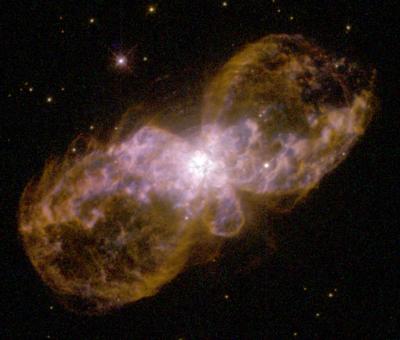 |
Figure 8. Hubble 5. Credits: Bruce Balick
(University of Washington), Vincent Icke (Leiden University, The Netherlands), Garrelt Mellema (Stockholm University), and NASA. |
According to J. A. Lopez et. al. in their paper "Morpho-kinematic analysis of the point-symmetric, bipolar planetary nebulae Hb 5 and K 3-17, a pathway to poly-polarity" (2012), this planetary shows a tight waist with a bright core. From the core emerge a complex set of filaments distributed as in a rosette configuration. For Hubble 5 some of these filamentary loops are proven for the first time in this work to actually be secondary expanding lobes. The nebular nucleus of Hubble 5 is very complex.
 |
| Figure 9. Stars patterns you can use to find this Milky Way planetary nebula. |
Even if you can use the naked-eye star 3 Sagittarii as a guide to find Hubble 5, you can also use a rich open cluster situated not too far from it. This cluster is nicknamed "Tom Thumb Cluster" (NGC 6451). Due to it is the most conspicuous object in the vicinity of Hubble 5, you should know that this planetary nebula lies just 39 arc minutes to the northwest of this stellar swarm, in case it unexpectedly be found first. Thus you can use it as a starting point to jump to the target.
There exists an HII region in the Local Group galaxy NGC 6822 which is known as Hubble V. Be sure to avoid troubles if you try to find a DSS image of the planetary nebula using the DSS-MAST-STScI web page. It will show a picture of that extragalactic HII region, at least you put "PN Hubble5" in the search box.
At 42x, Hubble 5 can be glimpsed. However, it is "hidden" among the surrounding stars of similar brightness, so that its identification is a little difficult. A good sky chart and a detailed field of view showing the surrounding stars is a must to get success searching for this planetary nebula. The blinking method, using a couple of nebular filters, was a good way to see Hubble 5 standing out among the stars at this low power.
 |
| Figure 10. DSS plates |
106x. At this magnification the planetary nebula is clearly visible even without a filter, appearing very slightly elongated and rather hazy in appearance. When Hubble 5 was seen using averted vision, two faint dots come into view, very close to each other and embedded in some nebulosity. At this power, the UHC was more useful than the Orion Ultrablock filter to improve the contrast of the target through the 8-inch telescope.
A final observation at 148x made possible to see the very tight pair of stellar features or dots. One of them is brighter. In the paper "The Complex Ionization Structure of the Planetary Nebula Hubble 5" Angels Riera et. al. (2000), the researchers state that there is a blow-up of the core region and no central star is observable, though ionization gradients all "point" to the dense center of the core. After checking the blue filter image provided by the STScI Digitized Sky Survey, the appearance of the planetary nebula through that filter is exactly the same I had of the planetary nebula, with the two starlike features (see lower panel in Figure 10). The brighter dot I saw seems to be the bright core visible in the colorful picture in Figure 8. Not too many details can be visible through an 8-inch telescope in small objects like this one. Surely, a more detailed report will be achieved in the future using a bigger telescope.
_______________________________________________________________________________________________________________
1_ A protoplanetary nebula or preplanetary nebula (PPN) is an astronomical object which is at the short-lived episode during a star's rapid stellar evolution between the late asymptotic giant branch (LAGB) phase and the subsequent planetary nebula (PN) phase.


