r .column-left-inner, column-left-outer { background: $(sidebar.bgl.color); } .column-right-inner, column-right-outer { background: $(sidebar.bgr.color); } .sidebar-right, .column-right-outer, #sidebar-right-1, .sidebar { background-color: #F5F7FA !important; padding: 15px; }

Translate / Traducir

Showing posts with label Henize. Show all posts

N79 & N83 Complexes in LMC


A Visual Observation of Interesting Structures in the Large Magellanic Cloud. Researchers Say one of Them Could be a Rival of 30 Doradus Nebula


Figure 1. The Complexes under observation
Early March, it is dark enough now (around astronomical twilight), so the Large Magellanic Cloud looks amazing, high in the southern sky. I am ready to aim the telescope (8-inch in diameter) to the west region of this galaxy, where the arm W is situated, to find and observe in detail other interesting complexes of our nearby galaxy (i.e. LHa1201-N79 and N83). The extent of these regions are outlined in Fig. 1b in the paper "Ultraviolet and Optical Observations of OB Associations and Field Stars in the Southern Region of the Large Magellanic Cloud"Joel WM. Parker  et al. (2000). In the 1° field of view (Figure 1) the white-blue star HD 31518 (magnitude 7.2) is the brightest one. Near the center, LHa120-N79 is visible along with its companion LHa120-N83, both are small regions of nebulosity with N79 appearing more prominent and "wide". These complexes reside in a bigger structure named Shapley VII, one of the giant stellar and gaseous groupings of the LMC that has an angular dimension of 48x25 arc min (PA 90°). Shapley VII lies in an even bigger structure named SGS2 7 that has an angular dimension of 55x55 arc min. In the field of view, toward the East of these complexes, a region showing a higher concentration of very faint stars embedded in subtle nebulosity, elongated East-West, can be detected. We are talking about LHa120-N94 which includes the OB association3 LH48, which encloses, in turn, the cluster of stars NGC 1767, discovered by John Herschel. A few brighter stars are superimposed in that region. This region seems to be connected to the two main nebulosities by very subtle nebulosity.

N79 is an irregular HII region, roughly 17x14 arc min in size, that contain the OB associations LH1 (also NGC 1712) and LH2. Its coordinates are R.A. 04h 52m 00s Dec. -69° 22` 30" (J2000.0). This region has a star formation efficiency exceeding that of 30 Doradus by a factor of ∼ 2 as measured over the past 0.5 Myr. The first observation of this object was made at low magnification (42x). The animation below showing the N79 complex (Figure 2) was made using a DSS image to show what I think it could be nicknamed the "Magellanic Horsehead Nebula" because it resembles, in my opinion, the profile of a horse. That section of the complex is called LHa120-N79E and is the most prominent one (see Figure 4), appearing as a rather elongated nebulosity E-W. Using averted vision the nature (as a nebula) of this object is more obvious, appearing somewhat wider and more contrasted. Some of very subtle nebulosity seems to lie in a small area southwest of LHa120-N79E. Higher magnification and nebular filters will surely help for a more detailed description of this area.

Figure 2. Zoom in  into LHa120-N79, a complex in LMC.
Using the same magnification we move to the complex N83, situated about 15 arc min northeast of N79.  Henize (1956) identified four ionized gas regions lying in that direction (N83A, B, C, D). Lucke & Hodge (1970) detected an OB association (LH 5) spanning over 16 square minutes (3600 square pc) around N83. It contains 26 blue stars (Lucke 1974) the brightest of which is Sk-69◦30 (Sanduleak 1970), a G5 Ia with a visual magnitude of 10.18 so it is the easiest star to see of three that are visible there (see paper "HST study of the LMC compact star-forming region N83B" by M. Heydari-Malayeri et al.). Another one of the three stars looks like a small roundish nebulosity where a star is visible within it when using averted vision. Actually, that star, Sk -69 25, is the main exciting object of the mentioned nebulosity which is known as N83A, also NGC 1743 (seeFigure 6)

At the same magnification a nebular filter, like UHC, improves the view of both complexes. N79E is visible, with averted vision, as a rather elongated nebulosity where a couple of stars are glimpsed for moments. With a similar configuration of that in N83 complex, three stars can be detected in the N79 area, to the south of N79E. One of them looks actually like a star embedded in a small and round nebulosity, this object is MCELS6-L25 (see Figure 4), while the other ones are the 10.7 magnitude blue supergiant HD 268718 and the 8.5 magnitude HD 31722. The whole area seems to be engulfed by very subtle nebulosity. 

Back in N83, the component N83A looks like a small nebulosity while the entire star-forming region seems to be engulfed by some nebulosity also.


Figure 3. The object H72.97-69.39.
Picture courtesy of Bram B. Ochsendorf.
Taken from the paper "The Star Forming
Complex N79 as a Future Rival of 30 Doradus" 
written by him and his team and included here
with his permission. 
The so-called high excitation blob5 N83B (also NGC 1748) which lies about 2.5 arc minutes north-east of N83A (Figure 6), and is around 25 light years in diameter, probably represents the most recent massive starburst in the giant HII complex N83 and the OB association LH 5. Heydari-Malayeri et al. (1990) discovered a compact HII region toward N83B. This object, which they named N83B-1, turned out to be a member of the so-called high-excitation blobs (HEBs) in the Magellanic Clouds. The brightest blob is the compact HII region N83B-1.

The zone of LH8 shows, through a UHC filter, smooth nebulosity, being more obvious toward the edge of the eyepiece field and less visible (maybe absent at all) in the zone between it and the complexes under study.

Now, a view of MCELS-L25, situated close to the 11.8 magnitude star RMC 54F (according to SIMBAD Database), with higher magnification (78x), shows a very small and detached hazy patch that looks brighter toward its center. N79E looks like an elongated structure where some stars, members of the OB association LH2 (NGC 1727), are embedded and associated with the nebulosity. Averted vision improves the view of this section.

Through this eyepiece, giving 78x, only N83A appears like a roundish object, compact, and with a hazy appearance. Some of nebulosity is hard to detect in the area where the object MCELS-L55 lies. 

Applying a UHC filter, the view of N79 and, in particular, N79E is very interesting. N79E is, by far, the most prominent feature there, where faint stars member of LH2 can be glimpsed using averted vision. For moments, and of course using averted vision again, the component N79D can be barely seen, very faint and round in shape. The star cluster KMHK 187 is associated with this nebulosity according to SIMBAD Database. MCELS-L25, through this magnification and filter, looks like a small hazy spot with a star-like brightness at the center.


H72.97-69.39, a precursor to the R136 cluster in 30 Doradus? 

At the heart of the large-scale complex N79 lies an extremely luminous object which immediately draws parallels to the central cluster of 30 Dor, R136 (Nayak et al.) (See Figure 3). Bram B. Ochsendorf and his team refer to it as ‘H72.97-69.39’ (I indicate it with red letters in Figure 4). This object is more luminous than any MYSO7 or compact H II region discovered with large-scale IR surveys of the LMC and Milky Way (read more in the paper "The star-forming complex LMC-N79 as a future rival to 30 Doradus" by Bram B. Ochsendorf et al. 2017). So, if you observe this region of the Large Magellanic Cloud with your telescope, remember that a peculiar and intriguing object resides there.


Figure 4. LHa120-N79 components
At this magnification (78x) and UHC filter, N83A is clearly visible being the most conspicuous feature (in brightness) of the whole complexes. It looks, as with lower magnification, like a round and small nebulosity with its star at the center. A very challenging object, difficult to see, is MCELS-L55, appearing like a ghostly round patch using averted vision.

There is a good view of the nebulosity in N79E using the Orion Ultrablock filter. Through this filter the stars associated look a little more clear. N79D is an elusive object and it could not be clearly visible at this magnification and this filter. On the other hand, MCELS-L25 appears like a small patch of nebulosity close to the 11.8 magnitude star RMC 54F.

In the complex N83, N83A is visible with not difficulty appearing more bright and nebulous than its counterpart in N79 complex. N83A reminds me a kind of small and bright planetary nebula. MCELS L-55 is elusive and a challenging object through this filter also. It seems to show up very briefly but I can not assure it is visible. It is, without a doubt, a good test for rods in your eye.

Using higher magnification...

Figure 5. N83B detailed image
Credit: M Heydari-Malareri & NASA/ESA.
106x is a good magnification to see the whole structure in the field containing the two complexes under study. Now the association LH2 and the associated nebulosity is visible in more detail. The star CTIO85 263 (visual magnitude 12.4 according to SIMBAD Database), is the brightest one visible in that association through an 8-inch telescope (indicated with an arrow in Figure 4). N79D is barely detected using averted vision, appearing seemingly round in shape. At this power, N83A looks now like a small and compact stellar cluster.

Through a UHC filter N79E looks faint, hazy, and without stars. The nearby structure N79D can be detected using averted vision but still elusive, faint, and challenging. It appears like a round structure separate from N79E by no nebulosity.

N83A looks bright, nebulous, and rather round in shape.

Figure 5 is a composite image of the region N83B taken by HST/WFPC2. The brightest blob is the compact HII region N83B-1 and the fainter one below it (∼100 in size) is N83B-2. The small arc-nebula further south, centered on a relatively bright star, is N83B-3.

Figure 6. LHa120-N83 components
A final observation of the complexes using 166x allowed me to see even more details. The component of N79, MCELS L-25, seems to be composed by two "star-like" objects, like two slightly defocused stars. N79E is visible with more detail, showing several stars embedded in faint elongated nebulosity. N79D is again visible, round, faint, and displaying smooth brightness. Averted vision is necessary.

N83A is clearly visible showing some faint nebulosity in its outer part. The section named MCELS L-55 is hard to see, challenging and faint. A few stars seem to be glimpsed embedded in extremely faint nebulosity.

Orion Ultrablock filter and averted vision make it possible to see two objects associated with nebulosity in MCELS L25. The view of N79D through this filter seems to get worse with respect to that obtained without any filter.

Another stunning formation in our satellite galaxy awaits to be seen by observers with telescopes during a clear night in the southern hemisphere summer.


________________________________________________________________________________________________

1_  LHa-120 N- This is the full name of an entry in the Henize catalogue of LMC emission nebulae. "L" refers to the Lamont-Hussey Observatory of the University of Michigan; "Ha" means the Hydrogen-alpha emission line, the key signature line used in the survey; "120" refers to the plate number (objective prism plate) for the LMC; "N" labels the object as a nebula, as distinct from a star (label "S").

2_ SGS are the supergiant shells, the largest of complex filamentary structures in irregular and spiral galaxies, indicative of a violent ISM, with diameters approaching 1 kpc (Goudis & Meaburn 1978). SGSs are thought to be formed by the fast stellar winds and supernova explosions of multiple OB associations.

3_ OB Association: The concept of a stellar association was originally introduced in 1949 by V. A. Ambartsumian, who later separated them into OB and T associations (Ambartsumian 1968). Morgan, Sharpless, & Osterbrock (1952) considered as a stellar association any loose group of stars within an area where bright OB stars exist and with evidence of a common origin.
A recent definition of a stellar association (Kontizas et al. 1999) refers to it as a single, unbound concentration of early-type luminous stars, embedded in a very young star forming region.

4_  LH is a catalogue of OB associations in the Large Magellanic Cloud compiled by Lucke & Hodge.

5_ The compact HII regions called High-Excitation Blobs (HEB) constitute a rare class of ionized nebulae in the Magellanic Clouds. They are characterized by high excitation, small size, high density, and large extinction compared to typical Magellanic Cloud HII regions. These objects are tightly linked to the early stages of massive star formation.

6_ MCELS means "Magellanic Cloud Emission Line Survey". This is a joint project of Cerro Tololo Inter-American Observatory (Chile) and the University of Michigan using the CTIO Curtis/Schmidt Telescope.

7_ MYSOs stands for Massive (>8 Msolar ) young stellar objects.


The Aggregate Shapley I in LMC


Nebulae and stellar associations reside in this complex in the central region of the Large Magellanic Cloud. How much can we see through an amateur telescope?


It is Spring in the Southern Hemisphere, so it is time to aim a telescope to one of our satellite galaxies, the Large Magellanic Cloud (hereafter LMC), and find another interesting structure there. The Magellanic Clouds show a large variety of bubbles, superbubbles and supergiant shells among its objects, many of them being visible for the amateur observers with common telescopes.

"McKibben and Shapley (1953) were the first to distinguish the giant stellar and gaseous groupings of the LMC, the well known Shapley constellations I - V. Later, van den Bergh named (in 1981) the constellations VI - IX. These seem to be the most active star forming areas of the LMC" (paper "Morphology and Stellar Content of Complexes in the Large Magellanic Cloud" M. Kontizas et al. 1995).


This video by ESO`s VLT is a zoom-in view of the interesting group of nebulae and OB stars  named LHa1201 N44, one of the targets you can observe with an 8-inch telescope.

This article deals with this complex which is also known as "Shapley Constellation I"  according to the LMC extended catalogue (Bica+ 1999) published in VizieR web pageN44, cataloged by Henize (1956) and named DEM2 150, 151 and 152 by Davies et al. (1976) is a luminous HII complex in LMC. It contains an assortment of compact HII regions, filaments, and shells of all sizes, as well as three OB associations3, LH447, 48, and 49 (Lucke & Hodge 1970)N44 is dominated by a prominent shell around LH47 in the central region (Chu & Mac Low 1990), paper "The Multi-Phase Medium in the Interstellar Complex N44" by Sungeun Kim et. al. 1998Situated at RA 05 22 06.9 Dec -67 56 46, N44 lies (see Figure 1) about 43 arc minutes southwest of a curious structure named "Sextant" (see the article "An enigmatic Structure in the Local Universe - part 2" in this blog). 

The observation was made from Uspallata valley, in Los Andes mountains, where the dark skies make possible to carry out this kind of projects. 

Figure 1. Position of the complex N44 in LMC. North is up.
Two main hazy regions are visible in the field of view at a first observation at 48x. I call them "northern region" and "southern region" (see Figure 4). The northern region is bigger than the other one but both look pretty similar in the sense that they show several faint stars embedded in nebulae structures. I identified this complex after recognize the T-shaped asterism formed by the stars HD 35862, GSC-9162-0453, HD 35978, and GSC-9162-0321 (visual magnitudes 9.3, 11.4, 9.7, and 11.4 respectively). The brightest star in the field of view is the 8.5 magnitude HD 35665. According with data given by the aforementioned catalogue (Bica 1999) the center of Shapley Constellation I lies at the center of the bigger region (indicated with the blue arrow in Figure 4). This aggregate has an overall dimension of 23 x 16 arc min and an angular position of 150° according with the same source (See Figure 2).

Matching with what can see on the DSS image (Figure 4), the area labelled with an ellipse is where nebulosity and stars are visible at this power. That is the area of the association LH49 and the HII region IC 2128 (also N44D). I found discrepances about the nature of IC 2128. Some sources (e.g. SIMBAD Database) state that is an HII region while others (like the revised NGC/IC catalogue and STScI DSS) say it is a stellar association. Beyond that differences, it is not a conspicuous object at all. The section easier to detect (a little better using of course averted vision) is the more contrasted patch on DSS image in Figure 4 immediately southwest of the 9.7 magnitude star HD 35978, appearing as a faint and defocused star engulfed, in turn, by very subtle nebulosity. Averted vision is necessary to get this view through an 8-inch telescope at low magnification. 

Figure 2. According with the LMC extended catalogue (Bica 1999)
Shapley constellation I is a 23x16 arc minutes wide structure with
an angular position of 150 degrees. North is up. East to the left.
Moving to the northern section of the complex, N44C (also NGC 1936, IC 2127) seems to be the most prominent nebula there, looking round and small.

A little higher magnification (63x) shows very subtle nebulosity encompassing the northern half of the "T" asterism. To the northeast, very faint and challenging is the view of the small component N44E (see Figure 4). With averted vision a ghostly nebulosity is visible. For moments, 2 or 3 stars can be discerned there. We will analize that region again using higher power.

At 63x, N44C is the most contrasted nebulosity visible in the whole complex. Stasinska et al. (1986) favour radiative radiation of N44C by a central star whereas Pakull & Motch (1989) suggest that it could be a fossil, X-ray photo ionized nebula formed by a now
Figure 3. LH49 & N44D
quiescent X-ray binary system. "The bright main body of N44C has the appearance of a normal H II region, apart from its high excitation and He II emission. The east, northeast, and northwest boundaries of N44C are relatively sharp and have low [O III]/Ha, indicating the presence of an ionization front" (paper "The He II Emitting Nebula N44C in The Large Magellanic Cloud: Optical/Ultraviolet Spectroscopy of the Nebula and its Ionizing Star" Donald R. Garnett et al. 2000). The area southwest of N44C is visible with averted vision as a rather smooth hazy spot. N44B is round in shape but slightly fainter and smaller than N44C. Even fainter is another round nebulosity, DEM L 140, to the northwest of N44B. It is smaller than the other two mentioned nebulosities. The OB association LH47 contains 40 blue stars according to Lucke & Hodge (1970) and appears, through an 8-inch telescope, as several stars embedded in a faint hazy background. Roughly north of LH47 we find another section of the complex visible like an elongated faint nebulosity (N44I) where a chain of few stars, situated in the same direction of the elongation, can be visible (surely members of the association LH48).

Using UHC filter...

Figure 4. The N44 complex
The view of the small nebula southwest of the star HD 35978 improves clearly using this nebular filter, being visible even with direct vision. It looks smooth without stars present there. Fainter nebulosity is visible toward the west, part of the N44D section of the complex. The shape seems to be a kind of triangle.

Through this filter N44C is, by far, the most contrasted nebulosity. On the other hand, N44B looks a little smaller and less contrasted but easy to see however. Beyond the view of the bright patches N44C and N44B, the nebulosity connected to N44C from the southwest is the most obvious section of the bigger area when using averted vision. The whole big section is visible even with direct vision however. The nebula southwest of N44C is slightly more prominent that the small and round patch DEM L 140. A dark lane crosses the zone between N44C and N44B. It seems to be situated closer to N44B. The view of N44I and LH48 improves using this filter.

Using averted vision a small hazy spot, the zone of BSDL 1363, is visible among the subtle nebulosity right west of N44B.

N44E is, without a doubt, the faintest area of the whole complex visible through a UHC filter at this magnification. It is hard to see, visible for moments using averted vision.


Figure 5. LH48 & N44I
118x, without filter, is a good magnification to observe N44. The zone of IC 2128 and N44D is visible involving three stars situated there. At this magnification the region N44K comes to the view being visible as a round, faint, and smooth hazy spot. Averted vision is necessary to see it. The stellar association BSDL 1449 is visible with averted vision as a short and narrow hazy strip. N44C and N44B look round in shape with the first one a little more contrasted and bigger. The dark area crossing between both objects is again visible. DEM L 140 is, as aforementioned, fainter, so averted vision must be used to see it better. A star or point-like core is visible within it. A region that looks similar to DEM L 140 at this power is the one immediately northwest of N44B, maybe slightly wider and showing also a central star. LH47 is a conspicuous association in the field of view. In the bigger section, the whole stellar and nebulae structure there seems to connect to the region LH48-N44I which appears as a faint nebulosity with a few stars associated.

Figure 6
Using a UHC filter N44D is visible with direct vision. N44K can be barely glimpsed also, while averted vision makes possible to see the whole southern region better. Moving to the northern region, the patches N44C, N44B, and DEM L 140 stand out. N44C looks smooth in brightness along with its extension to the southwest that also looks smooth and fainter than N44C. The nebulosity in LH48-N44I is a little more conspicuous through this filter.

At 160x the section N44H is visible using averted vision, looking rather irregular. N44K is, undoubtely, a challenging object for an 8-inch telescope. At this magnification a hint of nebulosity seems to be present among the faint stars there. The view of N44C, N44B, and DEM L 140 along with the association LH47 is interesting. N44C and N44B appear very similar in size, with N44C slightly brighter. Different than N44C that looks smooth, N44B shows a few stars embedded there. A short observation of N44C a few days later using a 24-inch telescope at 192x showed the nebulosity labeled with the arrow in Figure 6 as a smooth "cometary tail" or fan-shaped hazy structure emerging from the bright and round structure of N44C. Another dark lane, less prominent than that between N44C and N44B, is visible between N44B and the more elusive DEM L 140. The structure surrounding LH47 and connecting to the bright spots in the northern region (i.e. Shell 1) was not visible at any magnification. Using a 24-inch (61cm) telescope the loop Shell 1 was not visible neither.


Which section is NGC 1929?


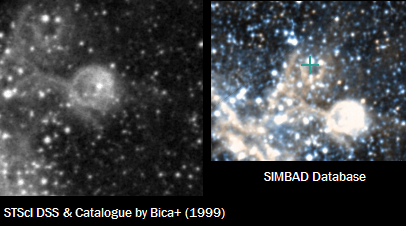
As with IC 2128, I found some discrepances about the object in the complex which is named NGC 1929. This situation is outlined in Figure 7. While sources like STSCI DSS web page
Figure 7
give the object indicated on the left panel, other good sources like SIMBAD Database indicate that NGC 1929 is the object on the right panel. An historical identification by Dreyer is the following, NGC 1929 (= GC 1135 = JH 2840, 1860 RA 05 22 02, NPD 158 03.6) is "faint, preceding of group", the latter comment presumably meaning it is the western member of a group of objects. According to the Revised NGC/IC project web site, NGC 1929 is a diffuse nebula or a supernova remnant. The ESO`s web page talks about a cluster of stars when NGC 1929 is mentioned. Have in mind these differences if you search for this object using these sources. In this article I adopted the designation DEM L 140.


The LMC, a surprising nearby galaxy to explore with your telescope from the Southern Hemisphere in spring and summer.


______________________________________________________________________________________________________


1LHa-120 N is the full name of an entry in the Henize catalogue of LMC emission nebulae. "L" refers to the Lamont-Hussey Observatory of the University of Michigan; "Ha" means the Hydrogen-alpha emission line, the key signature line used in the survey; "120" refers to the plate number (objective prism plate) for the LMC; "N" labels the object as a nebula, as distinct from a star (label "S").

2DEM is a catalogue of 357 nebulae in the Large Magellanic Cloud and 167 nebulae in the Small Magellanic Cloud that was published in 1976 by R.D. Davies, K.H. Elliot, and J. Meaburn. The LMC catalogue is DEM L and the SMC catalogue is DEM S.

3_ The concept of a stellar association was originally introduced in 1949 by V. A. Ambartsumian, who later separated them into OB and T associations (Ambartsumian 1968). Morgan, Sharpless, & Osterbrock (1952) considered as a stellar association any loose group of stars within an area where bright OB stars exist and with evidence of a common origin.

A recent definition of a stellar association (Kontizas et. al. 1999) refers to it as a single, unbound concentration of early-type luminous stars, embedded in a very young star forming region.

4_ LH is a catalogue of OB associations in the Large Magellanic Cloud compiled by Lucke & Hodge.


The N214C Nebula


An Emission Nebula, Containing a Rare Feature, Resides in a Nebulae Complex Tens of Thousands of Light Years Away From Us


Well, do not be afraid of the strange name of this object. It is, after all, an NGC nebula that any observer can detect when observing from the Southern Hemisphere even with telescopes as small as 8-inch of aperture.

Figure 1. The position of N214 in the Large Magellanic Cloud. North is up.
N214C1 (also NGC 2103, DEM L2 293, and MCELS L367) is an emission nebula included in the catalog of LMC emission nebulae published in 1956 by Karl Henize. This object was originally discovered by John Frederick William Herschel in 1834. With an estimated visual magnitude of 10.8, it is the brightest portion of a bigger nebula complex-N214-situated about 2° 15ʹ south of 30 Doradus, the most conspicuous nebular structure in our neighboring galaxy, the Large Magellanic Cloud. N214 is one of the southernmost complexes in our satellite galaxy, lying south of the stellar bar of that galaxy. It is a remarkable ongoing star-forming region containing at least 8 components, most of them very faint (see Figure 2) according to F. Meynadier, M. Heydari-Malayeri, and N R. Walborn in their paper “The LMC HII region N214C and its peculiar nebular blob”. This nebula holds the OB association3 LH 110 (Lucke & Hodge).
Most of the components are out of the reach of an 8-inch telescope, with N214C being the biggest and brightest portion by far, thus being visible through that kind of optical instrument.

At 42x, this object is clearly visible even without any nebular filter, looking like a slightly north-south elongated nebulosity of smooth brightness. A more detailed observation makes possible to detect, for moments, some brighter dots within it. Through a UHC filter, N214C is, undoubtedly, a conspicuous nebula. The filter improves the contrast of this HII region. Its overall shape is slightly elongated and its western edge looks a little less bright than the rest of this nebula (see lower panel on Figure 2).

Figure 2. The N214 complex (upper panel)
and the N214C nebula (lower panel) with
its two features. DSS image. North is up,
East to the left.
78x – At this magnification, N214C appears somewhat elongated ( overall oval shape of N214C) and some stars members of the OB association LH110 start to be discerned. These faint stars, embedded in the smooth nebulosity, have a longitudinal distribution coincident with the elongated direction of the HII region. In the central area of the nebula the brightest star of the whole object can be glimpsed, Sk -71°514, which is the main exciting source of the HII region and, in fact, is not a single star but a compact cluster (Garmany & Walborn 1987). It has at least 6 members (massive stars) in an area 4" wide. 

Using a UHC filter the view of N214C is interesting, being noticeable against the background sky with its shape being slightly elongated. An inner brighter zone containing at least one star or bright dot is visible at this power for moments using averted vision. This zone seems to have a slight elongation and its edges look somewhat fainter, with one of them appearing wider than the other. Orion Ultrablock filter helps to see the entire nebula more detached but it is not as useful as the UHC.

At 106x, N214C is an evident nebula at this higher power, appearing slightly oval in shape and showing a star-type feature in its central part matching with the position of the aforementioned stellar cluster SK-71°51. On the north-northwest corner of the nebula (see Figure 2what seems to be a very small nebulosity, fainter than the central cluster, can be glimpsed with averted vision, with a relative position with the Sk cluster almost parallel to the three stars took as reference (linked to each other with white lines on Figure 2). The opposite region, the southern zone of the nebula, looks narrower.
Through a UHC filter, this part of the nebulae complex looks pretty detached from the background sky. Some dark areas seem to be present within N214C, jumping to the view when is observed at this power. For moments, SK -71°51 also clearly jumps to the view. 

Figure 3. HEB in N214C. Photo by ESO
At 146x, N214C looks  elongated with SK -71°51 being clearly visible even with direct vision. More difficult to see (averted vision is necessary) is the stellar-shaped feature in the north-northwest region. That object matches with the position of the most remarkable feature of N214C (labeled as HEB5 on Figure 2), a globular blob of ionized gas at 60" (15 pc) north of Sk −71◦51 to which attention was drawn by Walborn et al. (2002). In photographs like that taken by ESO, it appears as a sphere split into two lobes by a dust lane (see Figure 3) which reminds me of a small version of the Centaurus A galaxy. The Blob`s mass would be 100 Mʘ. It appears as a sphere about four light-years across. Do not expect to see anything remotely similar to that through an 8-inch telescope though. The compact HII region discovered in N214C may be a newcomer to the family of HEBs (High Excitation Blobs) in the Magellanic Clouds, the first member of which was detected in LMC N159 (Heydari-Malayeri et. al.). The H II blob coincides with a strong infrared source, 05423-7120, which was detected with the IRAS satellite. 

The view with UHC filter shows N214C more round than the view without this filter. The sight through the Orion Ultrablock filter seems to be better than that through UHC at this high magnification.

Bigger telescopes will surely show more features of the N214C nebula and more subtle details on the features visible with smaller telescopes. 


Figure 4. DSS image
How to find N214

This complex lies in constellation Mensa, an inconspicuous group of stars between constellations Hydrus, Volans, and Dorado that are easier to identify in the summer nights from the Southern Hemisphere.

Figure 4 shows a 1-degree field of view centered on N214 (R.A. 05 40 54   Dec. -71 14 42), about 2° 15ʹ south of 30 Doradus as I said before. As you can see, N214 is, by far, the most prominent feature there. The other components of the complex, situated upper right of N214C in the DSS image here (i.e. N214A, B, D, E, F, G, H), and see in more detail on Figure 5, where the 7 faint components of the N214 HII complex are labeled, are targets for owners of big mirrors and/or astrophotographers. The positions of the components in Figure 5 were taken using data from the SIMBAD Astronomical Database.

If you have the opportunity of observing this small nebula immersed in our satellite galaxy in a clear and dark summer night from any place in the Southern Hemisphere, remember that some peculiar features reside in the depths of this deep sky object.


Figure 5. DSS image


____________________________________________________________________________________________________________


1LHa-120 N is the full name of an entry in the Henize catalog of LMC emission nebulae. "L" refers to the Lamont-Hussey Observatory of the University of Michigan; "Ha" means the Hydrogen-alpha emission line, the key signature line used in the survey; "120" refers to the plate number (objective prism plate) for the LMC; "N" labels the object as a nebula, as distinct from a star (label "S").

2DEM is a catalog of 357 nebulae in the Large Magellanic Cloud and 167 nebulae in the Small Magellanic Cloud that was published in 1976 by R.D. Davies, K.H. Elliot, and J. Meaburn. The LMC catalog is DEM L and the SMC catalog is DEM S.

3_ The concept of a stellar association was originally introduced in 1949 by V. A. Ambartsumian, who later separated them into OB and T associations (Ambartsumian 1968). Morgan, Sharpless, & Osterbrock (1952) considered as a stellar association any loose group of stars within an area where bright OB stars exist and with evidence of a common origin.
A recent definition of a stellar association (Kontizas et. al. 1999) refers to it as a single, unbound concentration of early-type luminous stars, embedded in a very young star-forming region.

4_ Sk-71
51 is the abbreviation of Sanduleak -7151. The American astronomer Nicholas Sanduleak published an important list of objects (stars and nebulae showing emission lines in their spectra) in the Magellanic Clouds in 1970. The “-71” in the name is the declination of the object, while the “51” is the entry number in the catalog.

5_ HEB (High-excitation blobs) are very dense, small regions (4 00, to 1000, in diameter corresponding to 1–3 pc)that are often observed lying adjacent or projected onto giant HII regions and are younger than the associated giant HII regions.