r .column-left-inner, column-left-outer { background: $(sidebar.bgl.color); } .column-right-inner, column-right-outer { background: $(sidebar.bgr.color); } .sidebar-right, .column-right-outer, #sidebar-right-1, .sidebar { background-color: #F5F7FA !important; padding: 15px; }

Translate / Traducir

Showing posts with label objetos de cielos profundo. Show all posts

The NGC 3256 Group


A Tidally Disturbed Galaxy, a Galaxy with a Double Nuclei, and Other Distant Members are a Group of Enigmatic Galaxies in the Southern Skies to be Explored by Amateur Observers


Figure 1.Pointing toward the zone where the galaxies are situated, in constellation
 Vela
In the eastern part of constellation Vela (the Sail) a group of faint galaxies (at least for an 8-inch telescope) can be found. March is a good month to observe this constellation because it is at a very good altitude as soon as the sky gets dark, so you can observe objects there for several hours during the last nights of the summer in the Southern Hemisphere. To find the area where this galaxies lie is easy because you can use one of the bright stars of Vela, the 2.7 visual magnitude m (mu) velorum,  a class G (G5) yellow-white giant. From there we can move to the stars HD 92139 and HD 91504 (visual magnitudes 3.8 and 5 respectively) to finally find the faint pair of stars of magnitudes 5.7 and 5.9 that are visible from any site that offers dark skies. Once there, the field of interest (centered at R.A. 10h 29m 25s  Dec. -44° 20`32") is roughly 52 arc minutes northwest of the mentioned pair. The galaxies are distributed roughly South-North (see Figure 3 below). Some researchers state that two groups of galaxies lie there, NGC 3256 and 3263, but are difficult to distinguish from each other spatially. However, many researchers consider at least 15 galaxies to be members of a single large group spread over roughly a few degrees that is called the "NGC 3256 group of galaxies". According to a group of researchers led by Jayanne English, "The most spectacular HI feature in the NGC 3256 Group is a galaxy-sized intergalactic HI cloud (English 1994), which we will refer to as “the Vela Cloud.” The structure, as projected on the sky, is not clearly associated with an individual galaxy but appears to be part of the group" (see the paper "The Vela Cloud: A Giant HI Anomaly in the NGC 3256 Group" (2010).

At low magnification (42x) the field does not show any bright and conspicuous galaxy. Focusing on the southern edge of the field of view (see Figure 3) a very faint hazy patch, somewhat elongated, can be glimpsed. Four stars in a row or a chain seems to lie there, among the galaxy. One of them seems to be the core of the galaxy (see Figure 2). Averted vision is necessary for a better detection. That is the  barred galaxy NGC 3261, discovered in 1836 by John Herschel. An historical identification by Dreyer is "faint, small, round, among stars". SN 2008fw, a supernova of type Ia, was discovered in this galaxy in 2008.

Figure 2. NGC 3261
Credit: The Carnegie-Irvine Galaxy Survey (CGS)
Moving about 15 arc minutes due north another galaxy very small in size (1.90 x 0.5 arcmin , PA: 135 ) resides, NGC 3256B, a  type SBbc galaxy with a magnitude of 13.0 (Data from Wolfgang Steinicke's Revised NGC and IC Catalog). It was not visible through this instrument at the different magnifications used during the observing session (from 42x to 266x). 

Moving farther north, another 18 arc minutes, we find a tidally disturbed galaxy, NGC 3263 (m_v: 11.1mag , SB: 11.8mag per square arcmin), included in category 7b "Jets from Spirals" in the Catalogue of Southern Peculiar Galaxies and Associations by Arp & Madore. At this magnification the galaxy is extremely difficult to detect visually. A very faint hazy structure seems to be there when viewing with averted vision. A close companion, NGC 3262, was not visible.

Reaching the northern edge of the field of view we find, at least on nice deep astrophotos, a couple of galaxies (i.e. NGC 3256 and 3256C), see Figure 3. The last one was not detected at this magnification. Although it is a faint galaxy, NGC 3256 (also AM 1025-433) is the "easiest" member of the group in the field appearing round and rather smooth in brightness when using averted vision. A. J. Mulia et al.  in their paper "Star Cluster Formation and Destruction in the Merging Galaxy NGC 3256" (2016) state that NGC 3256 is a merging pair of galaxies ≈ 36 Mpc away and the most luminous LIRG1 in the local universe.  The main body of NGC 3256 contains a dense population of clusters, many of which are embedded in the galaxy’s dusty interstellar medium. This galaxy shows two long tidal tails in optical photographs (e.g., Sandage & Bedke 1994).

Figure 3. DSS image of the galaxies in the field
These are, without a doubt, faint galaxies to be observed with an 8-inch telescope at low magnification, being only NGC 3261 and 3256 glimpsed in such a condition. Higher power is necessary for a more fruitful analysis of these distant objects.

At 78x, NGC 3261 is visible faint but with direct vision. It is situated among three stars (see Figure 2 above). Using averted vision, NGC 3261 looks rather round in shape. A small structure, slightly brighter, seems to lie in its interior.

NGC 3263 is a faint member detected using averted vision that makes possible to see it rather elongated with its central zone somewhat brighter.

NGC 3256C, a SBcd type galaxy, was not visible at this magnification. Its magnitude is 12.6, SB: 13.2 (mag per square arcmin).

The galaxy NGC 3256 is visible with direct vision at this magnification. Averted vision of course helps for a better detection. It looks round with a brighter core.

An observation at 106x shows NGC 3261 clearly distinguished from the surrounding stars. It is round and wider than NGC 3256. Toward its center the brightness increases and for moments a star-like structure shows up when observing carefully.

Figure 4. NGC 3263
Credit: The Carnegie-Irvine Galaxy Survey (CGS)
NGC 3263 and its companion NGC 3262 (which is not visible at this power) are visible on the picture to the left. NGC 3263 looks elongated for moments when is observed with averted vision and its brighter zone within it is again visible.

NGC 3256C is not visible while the nearby companion, NGC 3256, is easy to see at 106x, round and with a bright core.

A new analysis of the galaxies using even higher magnification was carried out. At 166x NGC 3261, which looks faint and round, shows a small "granulated" structure when using averted vision. Two stars, very faint and elusive, are visible there for moments.

NGC 3263 is still a faint and elusive galaxy, better viewed using averted vision. At 166x its elongated shape was not clearly discerned.

Figure 5. NGC 3256
Credit: The Carnegie-Irvine Galaxy Survey (CGS)

Is NGC 3262 visible through an 8-inch scope? 

You know that a faint galaxy, a challenging object for a given type of telescope, can be hard to see or glimpsed. The degree of difficulty will depend on how dark, steady, and clean is the sky when you are observing. According to an optimum detection method, an observer under a 6.2 limiting magnitude sky should detect this small galaxy, a companion of NGC 3263 (see Figure 4), using around 100x. Even if it was not a clear image at all, a very small hazy patch, round, seems to be barely seen for moments using averted vision. I was very careful identifying the nearby stars surrounding that target to realized if the gosthly image I glimpsed is the small lenticular companion of NGC 3263. It was also barely visible at higher magnification (266x). Observers with 8-inch telescopes are encouraged to observe this galaxy and get their own conclusion about its visibility. Even though NGC 3256B has the same magnitude than NGC 3262, it was not detected through an 8-inch telescope that night. Maybe the reason is that NGC 3256B is a little bigger in angular dimension (1.90 x 0.5 arcmin). NGC 3256C, with its magnitude of 12.6 and surface brightness 13.2 (mag per square arcmin) should be visible in an 8-inch scope, but for some reason it was not visible during the entire observing session. 

NGC 3256 is clearly visible showing its bright core that for a moment looked offset (maybe suggestion of the more expanded structure of the galaxy visible upper left on Figure 5?). NGC 3256 is included in Category 15 "Galaxies with Tails Loops of Material or Debris" in the Arp-Madore Catalogue of Southern Peculiar Galaxies & Associations. This galaxy also has a peculiar feature, a double (northern and southern) nuclei. Presence of an AGN2 at the optically obscured nucleus has been suspected for a long time. AGNs are often found among LIRGs.

Figure 6
A final observation of NGC 3261 at 266x makes possible to see the two aforementioned faint stars in the central region of the galaxy which looks round and smooth in brightness.

NGC 3263 looks, with averted vision, elongated. Brighter areas in the galaxy briefly jump to the view.

The central zone of the merging galaxy NGC 3256 looks rather smooth in brightness. Fainter structure of the galaxy is visible surrounding its core.

In the silence of the vast Universe, these galaxies await being observed by amateur astronomers from sites far away from big urban centers.

_____________________________________________________________________________________________________


1_ LIRG (Luminous Infrarred Galaxies)are galaxies with luminosities above 1011 L☉. These galaxies emit more energy in the infrared portion of the spectrum, not visible to the naked eye. LIRGs are more abundant than starburst galaxies. Infrared galaxies appear to be single, gas-rich spirals whose infrared luminosity is created largely by the formation of stars within them. However, some galaxies' luminosity comes from an active galactic nucleus or AGN.


2_ AGN (Active Galactic Nuclei) are galaxies where the nucleus (or central core) produces more radiation than the entire rest of the galaxy. Current theory suggests that there is a supermassive black hole (millions of times the mass of the sun) at the center of AGN.   


Remote Globular Clusters


Some of these swarms of old stars are Outer-Halo members of the Large Magellanic Cloud and are far away from it in the southern sky, appearing as "isolated" objects.


The Large Magellanic Cloud and its remote globular clusters.
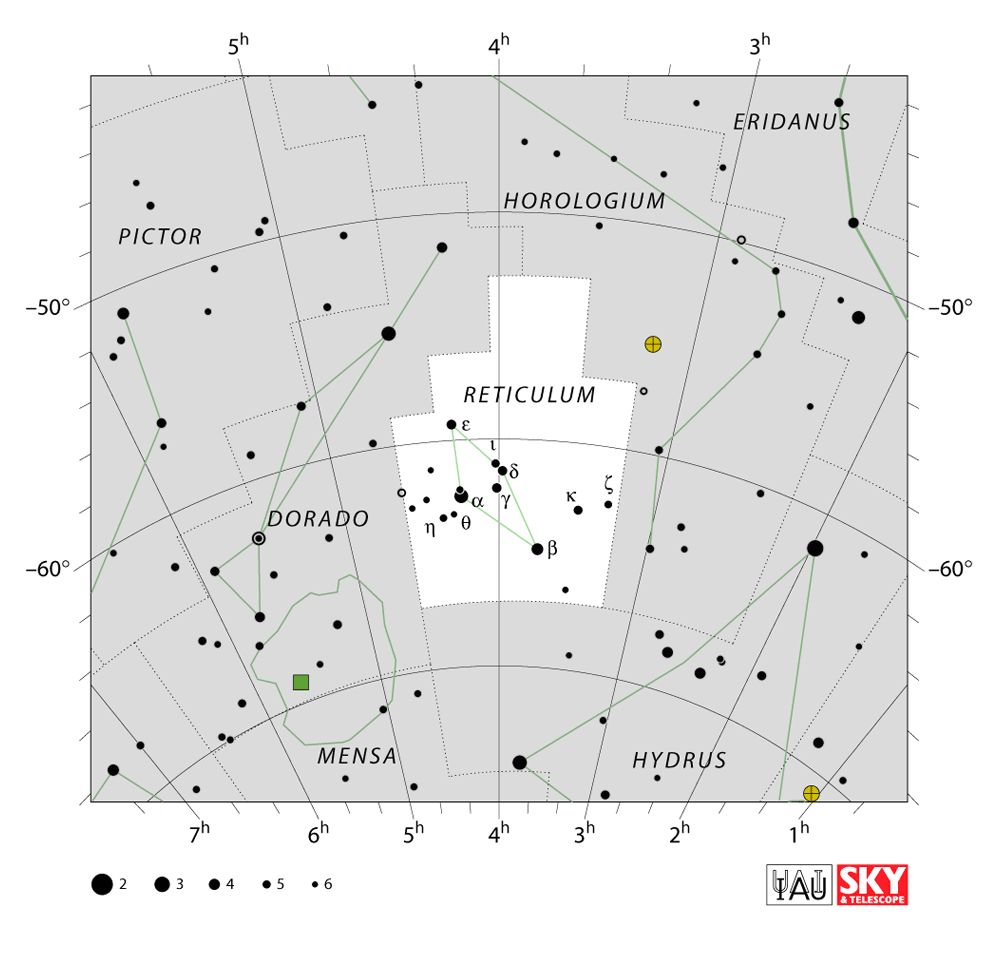
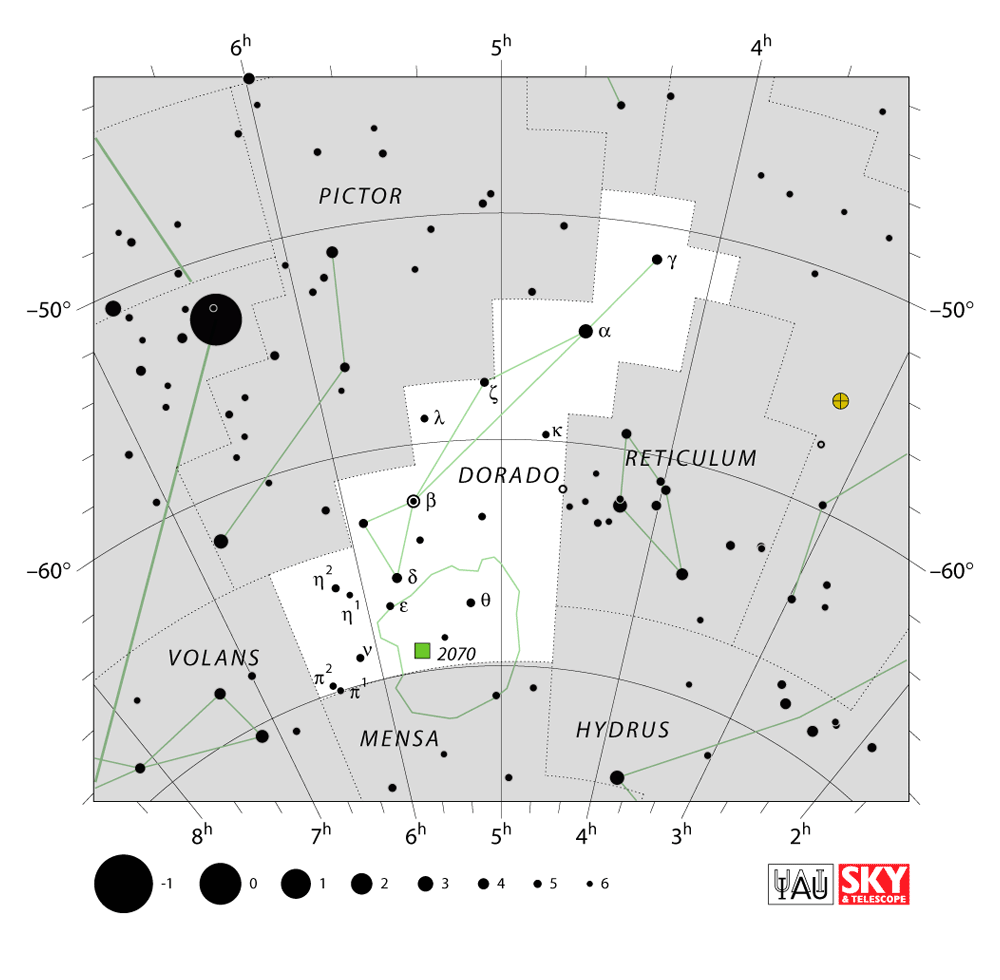
A conspicuous "nebulosity" shows up high in the sky as soon as it becomes dark, after sunset, on any summer day in the Southern Hemisphere. That "nebulosity", actually a nearby galaxy, the Large Magellanic Cloud (LMC), is surrounded by some faint constellations, namely Dorado, Reticulum, Hydrus, and Mensa. You can enjoy the view of these constellations from a dark sky site. Now, did you know that those constellations host globular clusters that are members of our satellite galaxy? Of course you will need a telescope, at least an 8-inch diameter mirror, to see some of them.

This article deals with 5 globular clusters that are situated far from the central bar of the Large Magellanic Cloud, thus appearing as isolated stellar systems in the southern sky, in the south celestial pole neighborhood.

From any place on planet Earth south of -31◦ of latitude, this five objects never set, being thus what is known in astronomy as circumpolar objects. However, the summer months in the Southern Hemisphere (i.e. December, January, and February) is the optimum season to see them at their highest.
The Large Magellanic Cloud (LMC) is unique in containing massive star clusters at all stages of evolution.  Reticulum, NGC 1841, and NGC 1466, three of the objects included in this article, have at times been considered to be Milky Way globulars (e.g. Webbink 1985). Bengt E. Westerlund, in his book "The Magellanic Clouds" (1997), states that these clusters are all outside the sky-projected tidal radius, but still considered to be LMC members.


NGC 1841
R.A. 04 45 23.4  Dec. -83 59 56.6 (J2000.0)

This is an extragalactic globular cluster situated in constellation Mensa, discovered in 1836 by John Frederick William Herschel. In projection on the sky, this cluster is situated 14◦5 south of the center of the Large Magellanic Cloud, close to the border with the southernmost constellation Octans (see map above). In fact, NGC 1841 is not too far from the south polar star Sigma (σ) Octantis (roughly 6◦5). NGC 1841 could have been formed in a relatively isolated fragment of the proto-LMC, or it could have been part of an independent system now disrupted. Further support to the latter hypothesis could be the fact that NGC 1841 is the farthest cluster from the LMC center (∼ 10 kpc) (paper "The relative ages of LMC old clusters, and the case of NGC 1841" by  Ivo Saviane, Alfred Rosenberg, Giampaolo Piotto, & Antonio Aparicio, 2002). Evidence is provided that NGC 1841 is younger than the rest of LMC globular clusters. 
Figure 1

I observed this remote globular cluster from a dark sky site, with a clear and steady sky that night. Although several sources give a magnitude of 14.1 for this object (which would make it a target out of reach of an 8-inch telescope), it could be glimpsed through an 8-inch telescope working at 42x like a very faint and hazy patch of light showing a smooth brightness. This supports my opinion that this cluster should be brighter than that magnitude. The value of 11.4 given by the Simbad Astronomical Database  seems to be much more accurate. It is visible through an 8-inch (20cm.) telescope according with Ernst Johannes Hartung`s book "Astronomical Objects for Southern Telescopes: With an Addendum for Northern observatories". Averted vision slightly improves the detection of it at low magnification. The star HD 34017 (visual magnitude 9.1, spectral type F3V) is, along with HD 31132 (magnitude 8.8), one of the brightest stars in the 1◦ degree field of view. I used HD 34017 and the patterns of stars encircled with blue ellipses as guides to find the exact place where NGC 1841 lies (Figure 1).

At 78x, NGC 1841 appears in the field of view relatively big, round, faint, and smooth in brightness. As with lower magnification, averted vision helps for a better detection of this elusive object for an 8-inch telescope. It was not possible to resolve the cluster in some of its members.


John Frederick William Herschel
106x is a good power to observe this cluster. It looks pretty big, faint, and smooth without resolved members. Even higher magnification (148x) makes the view of NGC 1841 not very good, appearing very faint and being difficult to see because of the low contrast. Optimum Detection Methods give, if we consider a visual magnitude of 11.4 and angular dimension of 0.9x0.9 arc min for this cluster, an optimum magnification of 80x under a 6.3 or 6.4 limiting magnitude sky, and 75x under a 6.5 sky.

Remember, beyond all the theory and methods for improving the detection of any deep sky object, the best you can do is to go to the mountains, or a place with dark skies, and have your own experience observing the targets in your observing programs. It is observing how you can draw your own conclusions about how difficult is to detect an object through the telescope that you have. But do not stop there, try to observe the same object in different nights, so you can compare the results. Every observing night is a unique experience that enriches your passion for stargazing.


Reticulum cluster 
R.A. 04 36 09.0 Dec. -58 51 30.0 (J2000.0)


Figure 2. Position of the Reticulum Cluster in the sky
In 1974, Sèrsic discovered an object in constellation Reticulum on plates taken with the 0.7m Maksutov telescope at Cerro El Roble Observatory. At first, he catalogued it as a probable dwarf galaxy and member of the Local Group. More recently, Demers & Kunkel (1976), and Gratton y Ortolani (1987) suggest that "Reticulum system" is a globular cluster of the Large Magellanic Cloud. Reticulum is an old and sparsely populated globular cluster that is located ≈ 11◦ from the center of the LMC (Demers & Kunkel 1976). Paper "Variable Stars in Large Magellanic Cloud Globular Clusters III: Reticulum" by Charles A. Kuehn et. al. 2013. Reticulum is classified as an OoI type1 cluster (Oosterhoff classification). It is located at approximately 11◦ from the LMC bar (l =269◦ , b=-40◦). 

This cluster resides in constellation Reticulum, very close to the border with Dorado (see Figure 2. Enlarge for a more detailed view). A way to find it is to use the stars Alpha (α) Reticuli, Alpha (α) Doradus, and Zeta Doradus that form a triangulum in the sky. The cluster lies roughly in the spot where bisectors of that triangle cross each other.


Figure 3
Once there, I observed the field at low magnification, knowing in advance that this is a faint globular for this kind of telescope. After identifying the star GSC-8515-1355 (magnitude 12) and the pair TYC 8515-1611-1 and GSC-8515-0765 (visual magnitudes 10.7 and 11.8 respectively) I focused on the small region between that stars (center of the field of view on Figure 3) to try to glimpse this extragalactic globular. Only a few faint stars are visible there at this magnification, surely foreground stars of our Milky Way galaxy.

At higher magnification (63x), the view is similar. The same stars are visible (labelled with blue circles in Figure 3). Even higher power (118x) did not show more than that faint stars scattered in the area. The faint star labelled with a red circle could be very barely glimpsed using averted vision at this last magnification.

As a final remark, this globular cluster is a faint object for 8-inch telescope. Owners of bigger mirrors should be glimpse this member of the Large Magellanic Cloud when observing from a dark sky site.


ESO 121-SC03
R.A. 06 02 02.50 Dec. -60 31 25.5 (J2000.0)

ESO 121-SC03. Picture from AladinLite view
ESO 121-SC03 lies at a projected angular separation of ∼ 10◦ from the LMC centre. It was first studied in detail by Mateo et. al. (1986). David Stevenson in his book "The Complex Lives of Star Clusters" (2015) estimates the age of this globular in around 9 billions years.

At 42x, the field where this object, also known as KMHK2 1591, is situated looks interesting with some stars forming fine shapes. The brightest star in the 1◦ field of view is the 6.4 magnitude SW Pictoris. The chain of four stars (indicated with blue lines in Figure 4), which contains the 6.9 magnitude star HD 41451 at its eastern end, and the stars forming a sort of crown (center of the field in Figure 4) helped to find the zone where this faint and obscure member of the Large Magellanic Cloud lies. This 14 magnitude cluster with angular dimension 2.0 x 2.0 arc minutes is, without a doubt, a faint object for an 8-inch telescope. Obviously at this low magnification nothing was visible in the field.


Figure 4
According with the paper "Photometry of Magellanic Cloud clusters with the Advanced Camera for Surveys - II. The unique LMC cluster ESO 121-SC03" by A. D. Mackey et al. (2006), this cluster may lie 20 per cent closer to us than does the centre of the LMC.

At 78x, ESO 121-SC03 is not visible after observing carefully under a dark and steady sky. I observed it again from another place, higher in Los Andes mountains, but I had the same results after using 118x. In both nights and from both sites, something seems to be there when observing with averted vision, but it is hard to assure that the cluster can be glimpsed. As I always say, if you are not sure you saw any object, you must say "I did not see it". 

The brightness of this extragalactic object reserves the view only for bigger instruments. Higher magnification (e.g. 160x, 222x) gave the same results, no object visible in the field.


NGC 1466
R.A. 03 44 32.4 Dec. -71 40 16 (J2000.0)

Figure 5
John Frederick William Herschel discovered NGC 1466 in 1834, a globular cluster with a magnitude of 11.4 situated in constellation Hydrus. It is listed, along with NGC 1841, 2257, and Reticulum, as one of the oldest generation globular (10 Gyr) in our nearby galaxy according to B. E. Westerlund in his book "The Magellanic Clouds" (Cambridge University Press, 1997). 

With roughly 8◦ of separation with the Large Magellanic Cloud in the sky, this member of our satellite galaxy is visible at 42x in a field that offers a beautiful image. The 6.3 magnitude HD 24188 is, by far, the brightest star in the 1◦ field, visible close to the cluster. This makes easy to find NGC 1466. At this low power, NGC 1466 looks like a slightly defocused star situated between the stars HD 24115 (visual magnitude 9) and the fainter GSC-9156-0534 (visual magnitude 12). At this magnification, the globular cluster reminds me a round planetary nebula. With averted vision, the core of NGC 1466 appears somewhat brighter.

NGC 1466. ESO Online DSS


At 78x it is possible to get a good view of the cluster and the stars surrounding it. NGC 1466 appears obvious in the field of view of the telescope. Even with direct vision the cluster shows some "granularity". Applying averted vision, at least two stars can be discerned.

106x seems to be a good magnification to observe NGC 1466, appearing very clear in the field of view as a round hazy patch. Some members of this cluster are easily discerned.

Even higher magnification, like 148x, is a good power to see this cluster under a very dark sky. You can see a nebulous patch and some stars within when using averted vision..


NGC 2257
R.A. 06 30 13.86 Dec. -64 19 32.2 (J2000.0)

Figure 6
NGC 2257 (also ESO 87-24, KMHK 1756) was discovered in 1834 by John Frederick William Herschel. NGC 2257 appears of particular interest since according to Stryker 1983, Nemec Hesser and Ugarte 1985 (NHU) and Walker 1989 (W89) it is probably the oldest LMC cluster. This object is situated about 8◦5 northeast of the LMC bar in projection on the sky.

I observed this LMC cluster when it was about 59◦ in the sky, just a few minutes after its transit by the local meridian, so that the altitude was the best to try to catch this old member of our satellite galaxy. At 48x, I could identify an asterism which I indicate with lines in Figure 6. This asterism was very userful to focus the atention on the spot where NGC 2257 should appear. This cluster can be glimpsed at this magnification, appearing as a very faint, round, and smooth patch of light immediately to the West of the stars TYC 8902-1763-1 and GSC-8902-0650 (visual magnitudes 10.9 and 12.4 respectively). Averted vision sligthly improves the view of it.

At 63x the view of the cluster is similar to that at lower power. Without a doubt, a "nebulosity" with smooth brightness and without any discerned star can be seen in the field. It looks round in shape. It is a faint object (magnitude 12.6) so averted vision helps for a little sharper image of the cluster against the starry field.


Figure 7
118x shows this object faint, a ghostly image of a globular cluster. Even with averted vision the view is hard and elusive. No stars are discerned in the cluster at this power. The angular dimension of NGC 2257 looks similar to the distance between the aforementioned stars TYC 8902-1763-1 and GSC 8902-0650 (see Figure 7).

There were not better results applying higher magnification (namely 222x). Again, a faint and featureless image of the cluster showed up in the eyepiece field. Even if NGC 2257 is visible through an 8-inch telescope, the view through bigger scopes should be more interesting and fruitful.


“Astronomy, as nothing else can do, teaches men humility.”
Arthur C. Clarke (1917-2008)


_______________________________________________________________________________________________


1_ The Dutch astronomer Pieter Oosterhoff noticed that there appear to be two populations of globular clusters, which became known as Oosterhoff groups. The second group has a slightly longer period of RR Lyrae variable stars.[39] Both groups have weak lines of metallic elements. But the lines in the stars of Oosterhoff type I (OoI) cluster are not quite as weak as those in type II (OoII).[39] Hence type I are referred to as "metal-rich" (e.g. Terzan 7[40]) while type II are "metal-poor" (e.g.ESO 280-SC06[41]).

2_ KMHK refers to a list of LMC clusters published in 1990 by M. Kontizas, D.H. Morgan, D. Hatzidimitriou and E. Kontizas (Astronomy and Astrophysics Suppl. Series, Vol. 84, p. 257).

The N214C Nebula


An Emission Nebula, Containing a Rare Feature, Resides in a Nebulae Complex Tens of Thousands of Light Years Away From Us


Well, do not be afraid of the strange name of this object. It is, after all, an NGC nebula that any observer can detect when observing from the Southern Hemisphere even with telescopes as small as 8-inch of aperture.

Figure 1. The position of N214 in the Large Magellanic Cloud. North is up.
N214C1 (also NGC 2103, DEM L2 293, and MCELS L367) is an emission nebula included in the catalog of LMC emission nebulae published in 1956 by Karl Henize. This object was originally discovered by John Frederick William Herschel in 1834. With an estimated visual magnitude of 10.8, it is the brightest portion of a bigger nebula complex-N214-situated about 2° 15ʹ south of 30 Doradus, the most conspicuous nebular structure in our neighboring galaxy, the Large Magellanic Cloud. N214 is one of the southernmost complexes in our satellite galaxy, lying south of the stellar bar of that galaxy. It is a remarkable ongoing star-forming region containing at least 8 components, most of them very faint (see Figure 2) according to F. Meynadier, M. Heydari-Malayeri, and N R. Walborn in their paper “The LMC HII region N214C and its peculiar nebular blob”. This nebula holds the OB association3 LH 110 (Lucke & Hodge).
Most of the components are out of the reach of an 8-inch telescope, with N214C being the biggest and brightest portion by far, thus being visible through that kind of optical instrument.

At 42x, this object is clearly visible even without any nebular filter, looking like a slightly north-south elongated nebulosity of smooth brightness. A more detailed observation makes possible to detect, for moments, some brighter dots within it. Through a UHC filter, N214C is, undoubtedly, a conspicuous nebula. The filter improves the contrast of this HII region. Its overall shape is slightly elongated and its western edge looks a little less bright than the rest of this nebula (see lower panel on Figure 2).

Figure 2. The N214 complex (upper panel)
and the N214C nebula (lower panel) with
its two features. DSS image. North is up,
East to the left.
78x – At this magnification, N214C appears somewhat elongated ( overall oval shape of N214C) and some stars members of the OB association LH110 start to be discerned. These faint stars, embedded in the smooth nebulosity, have a longitudinal distribution coincident with the elongated direction of the HII region. In the central area of the nebula the brightest star of the whole object can be glimpsed, Sk -71°514, which is the main exciting source of the HII region and, in fact, is not a single star but a compact cluster (Garmany & Walborn 1987). It has at least 6 members (massive stars) in an area 4" wide. 

Using a UHC filter the view of N214C is interesting, being noticeable against the background sky with its shape being slightly elongated. An inner brighter zone containing at least one star or bright dot is visible at this power for moments using averted vision. This zone seems to have a slight elongation and its edges look somewhat fainter, with one of them appearing wider than the other. Orion Ultrablock filter helps to see the entire nebula more detached but it is not as useful as the UHC.

At 106x, N214C is an evident nebula at this higher power, appearing slightly oval in shape and showing a star-type feature in its central part matching with the position of the aforementioned stellar cluster SK-71°51. On the north-northwest corner of the nebula (see Figure 2) what seems to be a very small nebulosity, fainter than the central cluster, can be glimpsed with averted vision, with a relative position with the Sk cluster almost parallel to the three stars took as reference (linked to each other with white lines on Figure 2). The opposite region, the southern zone of the nebula, looks narrower.
Through a UHC filter, this part of the nebulae complex looks pretty detached from the background sky. Some dark areas seem to be present within N214C, jumping to the view when is observed at this power. For moments, SK -71°51 also clearly jumps to the view. 

Figure 3. HEB in N214C. Photo by ESO
At 146x, N214C looks  elongated with SK -71°51 being clearly visible even with direct vision. More difficult to see (averted vision is necessary) is the stellar-shaped feature in the north-northwest region. That object matches with the position of the most remarkable feature of N214C (labeled as HEB5 on Figure 2), a globular blob of ionized gas at ∼60" (∼15 pc) north of Sk −71◦51 to which attention was drawn by Walborn et al. (2002). In photographs like that taken by ESO, it appears as a sphere split into two lobes by a dust lane (see Figure 3) which reminds me of a small version of the Centaurus A galaxy. The Blob`s mass would be ∼100 Mʘ. It appears as a sphere about four light-years across. Do not expect to see anything remotely similar to that through an 8-inch telescope though. The compact HII region discovered in N214C may be a newcomer to the family of HEBs (High Excitation Blobs) in the Magellanic Clouds, the first member of which was detected in LMC N159 (Heydari-Malayeri et. al.). The H II blob coincides with a strong infrared source, 05423-7120, which was detected with the IRAS satellite. 

The view with UHC filter shows N214C more round than the view without this filter. The sight through the Orion Ultrablock filter seems to be better than that through UHC at this high magnification.

Bigger telescopes will surely show more features of the N214C nebula and more subtle details on the features visible with smaller telescopes. 


Figure 4. DSS image
How to find N214

This complex lies in constellation Mensa, an inconspicuous group of stars between constellations Hydrus, Volans, and Dorado that are easier to identify in the summer nights from the Southern Hemisphere.

Figure 4 shows a 1-degree field of view centered on N214 (R.A. 05 40 54   Dec. -71 14 42), about 2° 15ʹ south of 30 Doradus as I said before. As you can see, N214 is, by far, the most prominent feature there. The other components of the complex, situated upper right of N214C in the DSS image here (i.e. N214A, B, D, E, F, G, H), and see in more detail on Figure 5, where the 7 faint components of the N214 HII complex are labeled, are targets for owners of big mirrors and/or astrophotographers. The positions of the components in Figure 5 were taken using data from the SIMBAD Astronomical Database.

If you have the opportunity of observing this small nebula immersed in our satellite galaxy in a clear and dark summer night from any place in the Southern Hemisphere, remember that some peculiar features reside in the depths of this deep sky object.


Figure 5. DSS image


____________________________________________________________________________________________________________


1_ LHa-120 N is the full name of an entry in the Henize catalog of LMC emission nebulae. "L" refers to the Lamont-Hussey Observatory of the University of Michigan; "Ha" means the Hydrogen-alpha emission line, the key signature line used in the survey; "120" refers to the plate number (objective prism plate) for the LMC; "N" labels the object as a nebula, as distinct from a star (label "S").

2_ DEM is a catalog of 357 nebulae in the Large Magellanic Cloud and 167 nebulae in the Small Magellanic Cloud that was published in 1976 by R.D. Davies, K.H. Elliot, and J. Meaburn. The LMC catalog is DEM L and the SMC catalog is DEM S.

3_ The concept of a stellar association was originally introduced in 1949 by V. A. Ambartsumian, who later separated them into OB and T associations (Ambartsumian 1968). Morgan, Sharpless, & Osterbrock (1952) considered as a stellar association any loose group of stars within an area where bright OB stars exist and with evidence of a common origin.
A recent definition of a stellar association (Kontizas et. al. 1999) refers to it as a single, unbound concentration of early-type luminous stars, embedded in a very young star-forming region.

4_ Sk-71
◦51 is the abbreviation of Sanduleak -71◦51. The American astronomer Nicholas Sanduleak published an important list of objects (stars and nebulae showing emission lines in their spectra) in the Magellanic Clouds in 1970. The “-71” in the name is the declination of the object, while the “51” is the entry number in the catalog.

5_ HEB (High-excitation blobs) are very dense, small regions (∼4 00, to 1000, in diameter corresponding to ∼1–3 pc)that are often observed lying adjacent or projected onto giant HII regions and are younger than the associated giant HII regions.